Table of Contents
Open Table of Contents
- Day 1: Rotterdam - Polish border
- Dag 2: Polish border – 50km before Belarussian border
- Day 3: 50km before Belarussian border - Minsk
- Minsk
- Day 4: Minsk - Moscow
- Moscow
- Meeting Russian hitchhikers
- Day 5: Moscow - Penza
- Day 6: Penza - Tjoletti
- Grushinski Festival
- Day 7: Grushinski - Samara - Ufa
- Day 8: Ufa - Chelyabinsk
- Dag 9-10: Chelyabinsk - Novosibirsk
- Day 11: Novosibirsk - Krasnoyarsk
- Krasnoyarsk
- Day 12: Krasnoyarsk - Taishet
- Day 13: Taishet - Severobaikalsk
- Day 14: Severobaikalsk - Tunda
- Dag 15: Tunda - Belogorsk
- Day 16: Belogorsk - Chabarovsk
- Chabarovsk
- Day 17 - Chabarovsk - Vladivostok
- Vladivostok
Day 1: Rotterdam - Polish border
In the morning, I stood up at 6.30 and said farewell to my girlfriend Petra.
Before 8:00, I got my first semi-official ride of the unequalled Jan Bass from the Weena petrol station The Finch. There I intended to hitch with a placard ‘Vladivostok’, you never know, but it turned out I had forgotten my drawing book to sketch hiking boards. My first error.
Then I asked a ride to some people who were refueling and after 10 minutes I managed a lift to filling station Bijleveld at De Meern plane for Utrecht. The driver was lively chattering who was living in Tholen. He worked 5 days per week at home because his boss gave him no travel expenses to compensate for traveling expenses.
I asked at Bijleveld another hike and got one to a filling station near Apeldoorn. The driver proved to be an Oud-Beijerlander (the town in which I was born) who was working for Getronics. As an It-er, myself I also have been working for this company some time ago. He was account manager for the sector care.
The petrol station where I was set down was situated at the E30 (A1). This road runs from Amsterdam to Moscow and I must not leave this one for the time being.
Got at that station by asking a direct ride from an Italian who speeded in his minibus in the direction of Germany. He spoke some English and I understood that he stayed the weekends in the Netherlands, and during weekdays at his wife and children in Germany. He was a road worker. He dropped me at a Raststätte before Hanover.
For lack of a hitch board, I approached drivers, which improves the chances. Moreover, you choose this way yourself your driver instead of being chosen. This is all the way more safely too. The next lift I got from Daniel, an inhabitant of Arnhem (a Dutch town) who for his work tidies up houses and hotels in Germany. He had much respect for my venture.
At Braunschweig he would leave the road. Just before he put me down at the filling station Zweidorfer Holz, a passing customs minibus halted us. There a routine research followed where we both had to leave the car. The customs submitted at first my backpack to a very thorough search. They found much interesting matter but nothing forbidden. At Daniel, however, they hit home. He had hided a big joint in its tobacco bundle. Furthermore, they found there a small pocket with four pills. Daniel told the officers these were medicines for his eye pains. He had put them in a small plastic bag, because he therefore did not need to take along with him the complete pillbox…
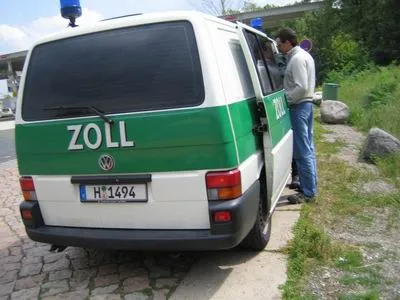
The customer’s car proved to be a mobile laboratory and the pills were subjected to a range of chemical tests. Something colored red which indicated amphetamine. Daniel got nothing of it but agreed rapidly with the 50-euro fine and the seizure of the found stuff. The agents recommended him to leave the medicines in the usual packaging and not to keep it in drugs like small pocket in his shag bag.
I aided spiritually Daniel a little. He was considerably fed up of course by so much injustice. Together we still head a coffee and then bade each other farewell.
After short time got by means of questioning a lift to Berlin from two Ossi’s who drove back home from the Hurricane festival (Rammstein, Queens or the Stone Age). They were real rockers with a lively car full of empty beer bottles and deafening rock music from the speakers. I gave them my card with my internet address so they could follow my travels.
I had myself put off on Raststätte Michendorf where I in former days, in DDR-times, sometimes had been with my parents to spend the last Ostmarks on glassy potatoes and hairy soup. This time I have nothing eaten there.
The next ride was with two Russians in a minivan. They reacted full disbelieve when I told them did my travel plans. The lived already 13 years in Germany and according to me they had someway lost the feelings with their homeland.
They brought me to a petrol station and adjoining lorry terminal about 3 km behind the border in Poland only not in my intended direction but more aiming at Zeleny Gorod.
There I made during about two hours for all freight carriages on the giant terminal, but nobody headed my direction. They went or to Southern Poland, or to Germany or continued to spend the night there. This did not make any progress. After two hours waiting, I managed a strategic lift to the border with a lively Polish lorry driver without semi-trailer. Its lorry rattled on all sides and had large problems with finding correct acceleration. The driver cursed lively (Kurwa) but got its truck moving with much bumping in the direction of the border.
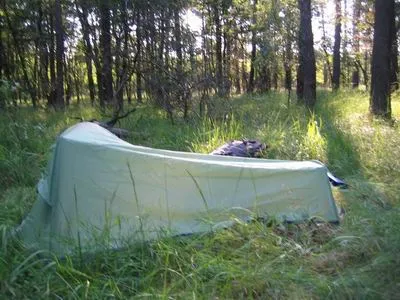
Plane for the border stood two Polish young police officers of about 18 years of age, which prohibited me to hitchhike so near to the border. That was rather shitty because now had to hitchhike along the road, a couple of hundred meters from the border, on a spot where everyone exactly was very well accelerating. It shimmered already and I had still no hitching board. I decided to pitch down the tent in this still little left daylight. This succeeded.
The end of the first day, everything went according to plan and I traveled about 900 km from the start.
Dag 2: Polish border – 50km before Belarussian border
The next morning I awoke early and rolled up the tent. When I stood at the road, again, the same young police officers stood there also and I still was not allowed to hike nearer to the border. The spot was miserable and therefore I decided after 10 minutes to walk in the direction of the terminal where I already had been rooted the previous evening.
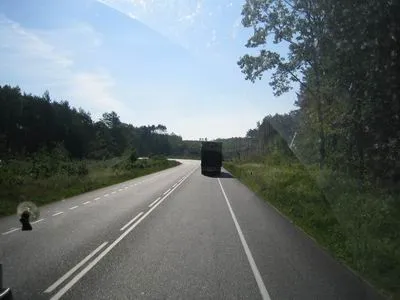
Then suddenly a Lithuanian lorry stopped which went into my intended direction and I was on my way!
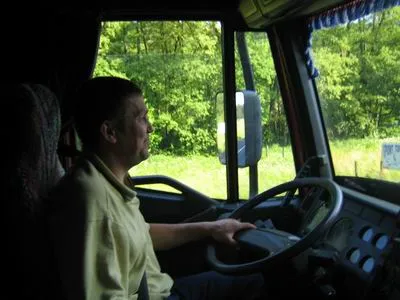
Driving did not go fast because of lack of a highway, much traffic, and dawdling by Alexandr. He had to drink frequently coffee and was searching for special offices which according to him were situated somewhere along the way. There special bills for expenses were fabricated which he possible could claim at his boss. After having even driven back for a stretch he at last found a likeably office somewhere behind a demolition firm at the side of the road.
It already was halfway the afternoon when I had Alexandr figured that it would make him a difference of 50 km. if he would drive by Warszawa in stead of taking a more northern route. He agreed and we kept on driving a stretch. On about 50km distance of Warszawa it appeared however that this road was prohibited for freight lorries. I did not know this of course. I was put down at a filling station to find myself at the wrong side of the road and left the lustily in Polish, Russian and probably also Lithuanian cursing Alexandr behind me.
There were on these spot three options:
- Hitchhiking beside the highway at an unfavorable spot
- Hitchhiking at the petrol station at the wrong side of the road
- Hitchhiking at the trucker’s restaurant.
A violent thunderstorm broke and therefore I chose for option 3. The driver sat the restaurant did not drive into my direction and one of them advised me even to return to The Netherlands.
I stayed until the end of the shower and took a bite and a drink. When it was dry again, but already as much as a little twilight, I still tried to get a lift on the unfavorable spot. After 30 minutes there, a hyphen code scanner salesperson stopped in an ordinary car who spoke English well. He told he already had left standing two hitchhikers that day. Once he had been collided from behind, he had pasted down his bumper with duck tape. However, it seemed to him it would improve his luck to take me along. He took me to the outskirts of Warszawa and on the way; we considered that it would be most skilful for me to take bus 125, which crosses the complete city from West to East. This way said, this way done. It was not possible to buy a ticket in the bus, so it was a free ride.
On the East side of Warszawa, I took another bus (502) which still went a couple of kilometers easterly to a filling station. That went rather smooth. The spot was favorable, but it was only meanwhile 22:30.
After half an hour, asking a Polish boy in a minivan proved to be very delighted to take me along. He was with a friend on the way from Frankfurt Main to Eastern Poland. The driver was very tired and needed much coffee.
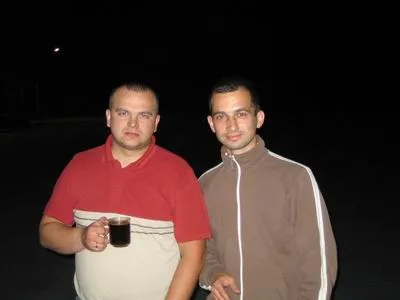
He told me he had driven 6000 km in 7 days in his minivan. That is something. Anyway, we had much fun and by means of shortwave, they made jokes with other nocturnal drivers. At 1:30, I was set down about 50 km from Terespol (the border of Belarus). There with authorization of the owner of the petrol station I pitched my tent on a beautiful spot. Satisfied I fell asleep.
Day 3: 50km before Belarussian border - Minsk
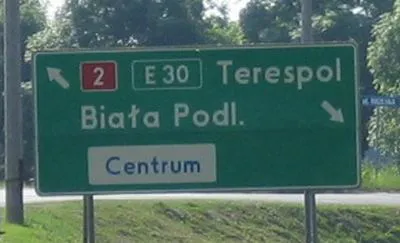
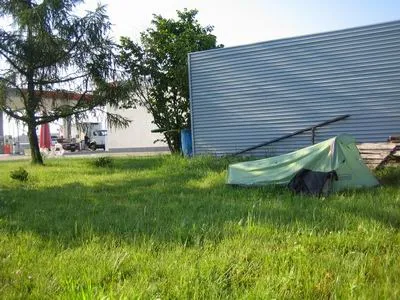 In the morning, I awoke at 7:30 and rapidly scored short lifts directions Terespol and behind. There I found myself standing hitch hiking on the wrong track because I misinterpreted a traffic sign. Then I found out I had to go simply straight ahead. I rapidly got a lift from a Polish couple to Brest near Belarus.
 Taken off with them I had also to have to go through the complete border procedure, which lasted 3 hours. There also stood still a convoy of 30 Belgian and Dutch campers and caravans, which were on holiday in the direction of St. Petersburg and Moscow. On the other side of the border I got a short lift from two fat, shorthaired Russian boys to a good hitchhiker spot on the other hand of Brest.
On the way I examined Brest from the car. The hitchhiking spot had been well populated with grouchy Russians, who probably were not hitching hiking for fun. I qued for good manners. After about 30 minutes, standing in the hot sun an old man in a decrepit Ford picked me up, whereas the other hitchhikers were still not all gone. The old man drove in the direction of Minsk. He had an appointment halfway with someone who came from Minsk. This one would be able to take me further according to my driver and this occurred. The two had a short shadowy discussion after which I could mount a brand new Toyota bus of the other man form Minsk. He was a young paunchy character who had much interest for the Netherlands. He brought me to the hotel in Minsk where I arrived before 18.00.
Minsk
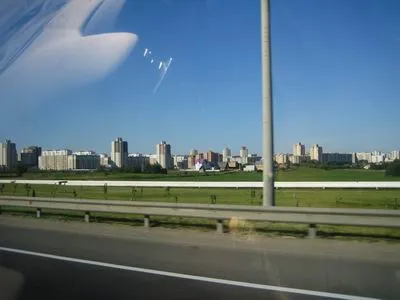
As some people told me, Minsk was indeed a very clean town. Hardly any litter and dust on the streets. The town had seen a total destruction in WW2. This gave the Soviets the opportunity to raise a model communist town: broad alleys, a stadium down in the centre of town, fast squares, parks and public gardens where all the seats were occupied, and no church buildings and furthermore rather dull from a touristy viewpoint.
The museums are not very interesting, except the war museum.
Eye-catching also is the lack of much advertising in the streets, much less than in Moscow for example. Most bus shelters are furnished with posters about the commemoration of the victory over Nazi-Germany. That theme lives on.
Minsk has been provides with a metro system with two lines and one can see tiny trams and trolleybuses. No much traffic is seen in the streets. However, as I already said so, everything is clean and well kept. No sings of dilapidation or dirty grubbiness as in other post-soviet towns.
I found a well working cash point and bought a SIM-kartochky. I spent my first night in a hotel. The booking could be advanced. I am one day ahead of my conservative travel scheme.
During my first shower in three days, I found a tick on my breast, probably caught in the Polish wood. The Xenos tick tongs got his baptism of fire and worked well. Now I have to wait for signs of Encephalitis. However, the risk is rather small.
After I explored the city June 17, in the evening it was my time to look for the address I booked via Hospitality Club. I already phoned my host, but noticed little enthusiasm. After I found Alexey, he turned out to be very cordial. It appeared that my voice through the phone sounds as Arabic-Russian and he was afraid he had to deal with an Arab.
Alexey is a computer science student and he will graduate next week. He lives in the heart of the town together with two other computer science students. He has a job at IBA, a company doing business in offshore programming for westerns customers. Their biggest customer is IBM. IBA formerly was part of IBM. They made a content management system for an English customer. He demonstrated it and it looks very nice: it was possible to define object types and the relations in between them.
He is also occupied by an old Russian self-defense sport and he is a drummer. He had a job for one year in Miami to earn money for paying his study. His housemates also were working to pay for their study. One of them even worked in the building trade in Naples, Italy.
Striking was neither of them had a bed. They are sleeping on a blanket on the ground. Because of this, they have by day more living space; however, the rooms were not small at all. In the whole house, no television set is to be found. All three of them do have a modern PC with the works.
Day 4: Minsk - Moscow
In the morning, I stood up at 7.30 and after a fast cold shower said farewell to Alexey. Then with the underground railway to station Bostok and there I took bus 99 to the terminus. When we drove to the last bus stop I saw already a hitchhiker standing, flat behind a police station. I decided to walk there and just have a chat with the hitchhiker.
Exactly when I address him, a car stopped for him stopped. The hitchhiker asked the driver if he would take me along too and that was possible. The driver, Dima, appeared to have lived a year in Antwerp and had been a couple of times in Rotterdam of which he had clear and nice memories.
It appeared that he directly drove to Moscow! So, that was settled. The other hitchhiker was called Vjaza and was 19 years old. He remembered my mail on the Russian Backpacker forum and was very glad to meet me! He invited me immediately to come to Jaroslavl. He repeated the invitation several times during our travel and enforced them by adding with all kinds of descriptions of this 1000 years old city and its curiosities. It sounded tempting although it, however, was situated 250 km in the wrong distance.
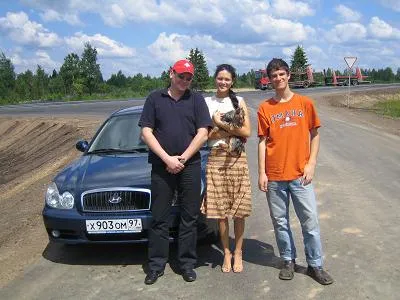
In Belarus Dima drove rather steady because he had no Belarusian money for petrol. We refueled with my last money and then we could drive faster.
I made myself already up for a heavy border crossing but this proved to be out of the question. However, there was a fast lorry traffic-jam and private cars could keep on driving without passport control. Belarus and Russia forms a type of union or something like that. There are unfortunately as much as two visas necessary but the forms, which I had filled at the Polish - Belarusian border, is valid for both countries.
Once we reached Russia, the speed increased rather well and from time to time, we reached a180 km-speed on the excellent motorway. The other hitchhiker had told me that maximum speed until then had been 160; therefore, it was an extra reason for Dima to raise this high watermark. Furthermore not unsafe.
After a very sociable ride of about 8 hours, we reached Moscow. Everyone was glad. The other hitchhiker was put down at an underground railway station and Dima started asking me what plans my plans were. These were rather vaguely, I must admit, I had a list with phone numbers and hotel charges, but concrete things I had not yet considered. Then he invited me to his house.
That proved to be a complete nicely wide apartment in Southern Moscow. Rapidly even took a shower and after I had ironed my trousers on insistence of Dima went we to a Ukrainian restaurant.

A little bit of vodka, Borsch, and Salo (blank animally fat that in the Ukraine is considered as a delicacy). On the way to home, I still bought some DVD’s and breakfast for the next day. At night drank some whiskey and examined the portfolio of Anja examined, who does model work. Driving through Moscow, she designated her colleagues on the billboards. Furthermore, we watched the film Madagascar: a must. I got for a present a DVD of the film Fandorin, from the novel of Boris Akunin (Fandorin, a corruption of the Dutch name Van Dooren, is the Sherlock Holmes of Russia) and a large bottle strong Belgian beer, which proved to be later German and of which Oleg got rid of at breakfast.
Fallen satisfied asleep in a super bed.
Moscow
Already the fourth day in Moscow. The first evening spent the night at the house of my last chauffeur, the rich Russian with his 19-year-old girlfriend who is working as a model. We had dinner in a Ukrainian restaurant, expensive single malt whiskey and watched the film Madagascar on DVD. I slept well en at the breakfast the next morning surfed the Net at the gigantic laptop on the kitchen table.
Monday went tot the hotel where Arnold – a fellow student Russian language course- had just arrived after his two-month stay in the Ural at Perm.
We exchanged our experiences and then went into town. In the evening, I had an appointment on the Red Square with Oleg, my friend from Kiev. We had the usual evening and day with Oleg, very enjoyable if it does not last too long. Oleg had not been in the centre of Moscow for 20 years. In the evening, he returned to Kiev.
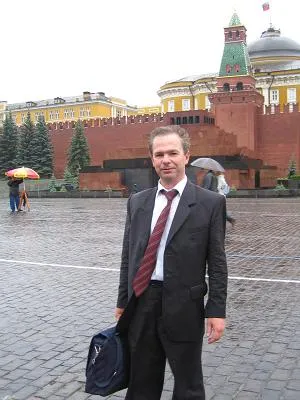
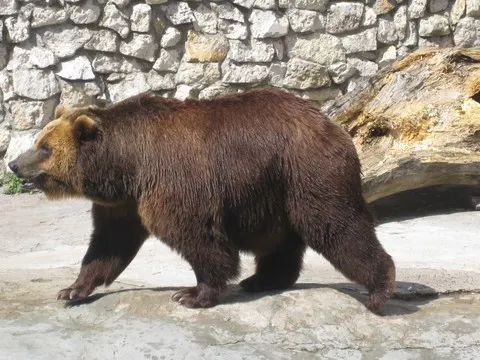
Wednesday I went to the zoo with Arnold and his Tatarian friends Veronica and Marat. The weather had increased and the zoo was enjoyable.
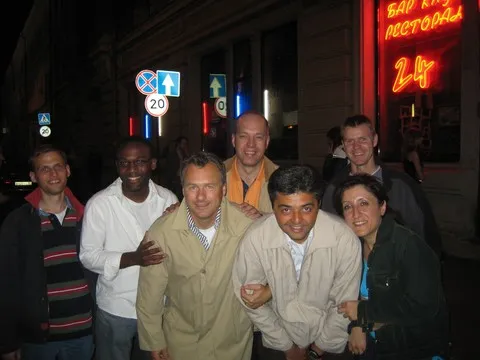
In the evening had an appointment with a Dutch acquaintance of Arnold, Arjen. Arjen is decent fellow from Spike-City who sells special cables for businesses in Capelle. He had visited Murmansk and he enjoyed Moscow. He was the real life and soul of the meeting and soon enough we were dancing in nice pubs and we joined a group of CMG’s. They had been to a telecommunication market and now sat in relax mode. When I said farewell to Arnold and Arjen it was very late, but they subsequently visited another pub. I went home by taxi and had a nice chat with the driver.
Thursday I suffered a bummer when it was not possible to stay another night in the hotel. Now I am looking for an other bed, probably at Lena’s, the girlfriend of Lena from Rotterdam. It means I have to drag my backpack through entire Moscow. The fact I am not looking forward to this supposes I left temporarily the lift mode and assumed a touristy comfort level. It is high tide I leave this again and exchange my hotel room for a place on the floor, to replace my fresh armpits with full-bodied sweat and to find quickly some hitchhikers to give me useful information for my route.
Meeting Russian hitchhikers
Yesterday I found a new place to stay with Lena, who lives in a spacious apartment right on the outskirts of Moscow. After a pleasant meal at her place, we went out together last night to look up a few Russian hitchhikers, which she also found interesting.
First we met Sergei Karitich, webmaster of hike.ru, the Russian hitchhikers site. He spoke excellent English, since he works as an interpreter-translator. He had never hitchhiked to the Far East of Russia, but had done so many times to Western Europe, always travelling via Finland from St. Petersburg.
I agreed with Sergei that I’d report my progress to him every now and then, which he would then post on Hike.ru.
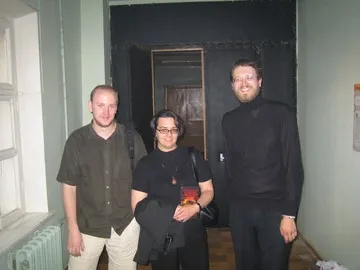 With him we then went to look up a certain Oleg. Oleg is the tallest Russian I’ve met so far (>2m) but otherwise looked like a garden gnome. He was still working at an archive right near Red Square. Oleg hitchhiked from Moscow to Cape Town last year — hats off to that.
He’s a ‘well-known’ member of the AVP, the academy of free travel, in Moscow. Membership is by invitation only, and only comes up once you’ve clocked more than 100,000 km of hitchhiking experience.
He gave me a number of very useful little books. The information in them is also on the AVP site, but these booklets are handier to have on the road. All the booklets were written by Anton Krotov (1976), who has by now hitchhiked to many far corners of Russia, and has also hitchhiked through Africa, Afghanistan, Iran, Syria, and China.
-
The practice of free travel. Krotov’s first book, and a really good introduction for any Russian who feels like travelling without spending a fortune on it. It covers subjects like choosing the best route, techniques for stopping cars in all kinds of circumstances, formulas for working out your daily speed, how to find places to sleep in unfamiliar cities, how to get food cheaply, how to arrange a free shower, what the best gear is, how to behave when staying with strangers, etc.
The AVP’s slogan is ‘наука победит’, which roughly translates to ‘science conquers’. The single most important and only absolutely essential piece of gear, the book argues, is your own 1500 grams of brain.
I already knew this book, but it’s great to have it now in a fixed, handy format. Krotov is a good author who knows how to write engagingly. Thanks to his booklets, I’ve already missed my stop on the metro twice today. -
134 questions and answers. Krotov self-published his first book and sold it in huge numbers at festivals, concerts, and on trains. It really struck a chord with a certain group of young people and with poorer (ordinary) Russians in general (a relatively large group). The success was overwhelming, and Krotov became a role model for many. His ‘followers’ are also known as ‘Krotovniki’, and honestly, I’m one of them too.
Krotov publishes his home address, email, and phone number in all his booklets, and he soon had to take all sorts of measures just to get a bit of peace and quiet for himself. One of those was writing the second booklet, in which he answers 134 questions he’s frequently asked. A selection of the questions:
- Do you often end up in unpleasant situations?
- Do accidents involving hitchhikers happen often?
- Do you ever lie?
- Do hitchhikers ever die?
- What do you do when drivers ask for money?
- I want to travel with you!
- Is it hot in Africa?
- Are there countries poorer than Russia?
- Do you ever drink vodka?
- How do I hitchhike in winter?
etc. etc. Really fun to read, and nice to have too.
-
The encyclopedia of ‘free’ travel.
This book is the most useful one for me. It consists of 277 pages in A5 format, completely crammed with barely readable tiny print. It describes all the major roads, cities, hitchhiking spots at every city and how to reach them. It has tips for cheap places to eat, sights worth seeing, and it tells you, for every city, where the permanent hangout spots are where you can meet kindred spirits. It contains at least as much information as the Lonely Planet for Russia, which I left at home this time. A truly excellent book. -
All the elektrichkas of Russia
From every city of any significance in Russia, electric trains run connecting the city with its immediate hinterland. They often go 100 km or further out from the cities. These so-called elektrichkas form a large network, and in the European part of Russia it’s often possible to travel from city to city via the elektrichka network, if you have patience. Elektrichkas are only loosely conducted, so it’s often possible to ride for free too.
This book is also in A5 format but uses an even smaller typeface. Just barely legible, it lists all the departure times of every elektrichka, and believe me, there are a lot of them.
I paid a small amount for them; later, once I saw everything I’d actually been given, I thought a bit more would have been fitting, but there’ll still be a chance to pay more at the festival. Armed with these books I feel a lot more confident.
The AVP has set itself the goal of providing information about free travel to anyone who’s interested. So I talked through the rest of my trip with Oleg, and we made an inventory of the difficulties and possible dangers awaiting me:
-
Alcoholics. Found all over Russia, but tend to wander along the roads in Siberia rather often. Drunk drivers are quite rare, according to Oleg (alcoholics have usually already sold their car, and the police are very strict about drink-driving). Advice: stay calm, don’t shout at them, don’t talk to them, and calmly walk away.
-
Ticks. Advice: cover your skin when walking through a forest, and check yourself thoroughly when you come out again. If after a while you start feeling weak, you might have caught the disease. In that case you need to see a doctor.
-
The Chita–Khabarovsk stretch. There’s no asphalt there, and hardly any traffic at all — a few cars per hour, or even fewer. Advice: have patience.
-
Police. Officially, the law still exists that you must register in any city where you don’t live. This also applies to Russians themselves. In practice, this is of course not feasible for a traveller/hitchhiker.
In European Russia it’s all more or less tolerated, but in remote areas this law can sometimes be followed rather irritatingly strictly by the police. Advice: have patience, or, if unlucky, get sent home by plane at your own expense.
Day 5: Moscow - Penza
The journey from Moscow to Penza (600 km) went well. In the morning, I awoke early and took a shower. First, I had to remove the cat litter from the bath. After an hour traveling by metro and bus, I stood at the starting point of the M5. This road runs from Moscow, by way of Penza and Samara to the Urals to Cheljabinsk. Overall, it is a stretch of 1800 km.
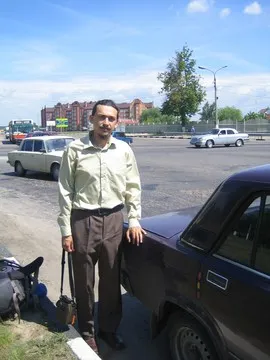 After ten minute Anatoli halted, who took me along to the village of Lychovitsji, some 120 km. Anatoli appeared to be a fanatic Christian. His car was hanged with little icons. In addition, when I told him about my present journey he crossed himself and repeated this dozens of times during our ride.
At each church we passed he crossed himself, but also sometimes at his own liking. He was on is way to a ‘starets’. This is the name of a mystic seer/saint with special gifts and a broadband connection with the spiritual world. You could call him an orthodox version of a medicine man. On our way, Anatoli wanted to visit the grave of an other starets, called Nila, who died shortly and now would quickly being canonized. As we approached the church, Anatoli crossed himself elaborately. A priest who walked there was kissed on the hand. In the church Anatoli kissed the icons.
Behind the church, a special little building had been erected wit the grave of Nila in it. It was covered with sand and circled by vases full of flowers.
Anatoli suggested I would ask her to bless my journey, but I did not like this. He went into the building, sat on his knees for a long time, and pressed his head on the sand, which covered the grave. He put a beautiful rose in one of the vases and again kneeled. After this, he went to the special shop and bought a photograph of Nila, an old woman with hanging cheeks. The photograph he pushed some times again his face and pinned it down in his car. Instead of giving money to the beggars at the church, the al received a banana from him. I must honestly say I became a little bit ill from this much devotion and piety.
When we drove further on, he told me about Christianity in Russia. Since 2000 years, nothing had changed. That is why it was the only true Christianity. He told about the dyxovol mir, de spiritual world around us, which is filled with little green devils. Devils of prostitution, of alcoholism, etc.
Anatoli told about Russian women seeking western men by way of contact agencies. He compared this with a pan full of fresh milk. After some time the best nice light foam is floating, under that rests the milk and the dirty lumps of fat are sinking to the bottom. Women who are looking for a western man are those dirty lumps.
On our way, we passed the exit to the village of Gzelj. During my former hitching trip, people told me that the blue Delft wooden shoes, which I gave as presents, are not typically Dutch at all. They are Russian souvenirs named Gzelj. Anatoli told me that Peter the Great after his journey to Holland, had ordered to build a factory here to produce china from Dutch examples.
I got off in the hamlet Lychovitsi and Anatoli blessed me. I was very decent of him you give me the phone number of some of his acquaintances in Chita. Maybe it would come in handy later on.
In Lychovitsi hang a funny banner: Russia has three capitals: St. Petersburg, Moscow and Lychovitsi.
Quickly I got a ride again in a little truck with a sober driver but not so sober passenger, who liked some company. Alexander the driver was an Okay man with a refined opinion about foreigners, Muslims, integration policy, etc. Instead of taking the ring road, we drove especially through the town of Rjazan, so I could take some pictures. He offered me some times vodka (medicine as he called it) but I refused. He did understand this and thought this sensible. A stretch behind Rjazan I was dropped off.
The next ride followed quickly. It was a rather silent soldier on leave in a Zjigula car. We drove thorough magnificent scenery until Zubova Poljana, situated in the autonomous republic of Mordovia with the capital Saransk. There I had to wait an hour for the next ride. Some stray dogs roamed there of which I am not a fan. I walked some hundreds of meter further on where road works were carried out at a bridge over the river Vod. All cars had to halt at a traffic light over there and not before long, I could get in a truck which usual transported cars. When I got in it appeared a drunken man was in the sleeping berth. He was the brother of the driver who came along with him. He drank a whole bottle of vodka in Moscow.
I noticed again that Russian who did not drink themselves, because they had to drive, had quite fun in company who had drunk alcoholics. The driver’s cabin was quite a mess, but both men were nice company and asked a lot about my journey and about Holland. Lied again about my age and income.
The driver was a look-alike of Kevin Kostner; His drunken brother was a butcher and told me over and over what a superb brother he had and how much he loved him.
The lorry had no freight and on some stretches drove 120 km/h. I asked if no limiting device was on the vehicle. Kostner told me he had let installed a special button with which the device could be switched off. Plain on the dashboard.
Nature still was marvelous and we passed tiny villages with churches of which the shape varied from dilapidated to recently restore with shinny cupolas, which could be seen from a far of distance, glistening in the sunlight.
Near Penza I got of the truck and the M5. With a taxi to the town centre and found a decent hotel. The end of a superb day.
Day 6: Penza - Tjoletti
After a day in Penza, I left in the evening town by elektrichka to the M5. De elektrichka ran very slow and it was not before 21.00 I arrived in the village of Chaadevka. It was still a walk of 500 meters to the hitching spot, but I decided to pitch my tent instead of hitching. A whole army of midgets pestered me, but they did not come into the tent. I received SMS’s from Lena and Jan de Bas. Some noisy creatures crept along the tent, but luckily no homo sapiens.
I awoke at 8.00. The weather was rather overcast with tempting rain. Near my lift spot, on top of a hill where drivers could see me well, a police car stood. That was no invitation for cars to halt and I walked a stretch further on. The drizzle became a downpour and I sheltered under a lean-to. When the rain stopped the police car drove away and I quickly returned to my hitching spot.
I quickly got a hitch from Evgeni, a soldier who was on his way tot Kyznets, 30 km further on. He thought I was a super hero. He also wanted to travel some day. He had crossed all Russia during his military career; the far east, Chabarovsk, Afghanistan, Chencheninguhs. The last resort had not been a nice stay. His salary was modest, only he was forbidden to travel abroad. His wife, who was a teacher in the German language, annoyed this. She rather liked to go to Germany once. After 5 years of leave, he was permitted to do this.
From Kyznets it lasted some time before someone gave me a ride.
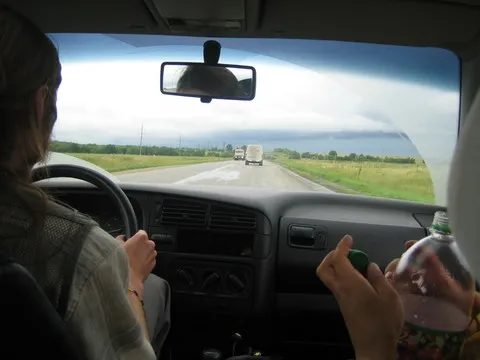 A white Volkswagen Golf from Belarus halted with two counter culturists in it. They were headed to the Grushinski Festival and they drove me to Tjoletti. The two men chatted only to each other and horsed around, which was not entirely safe. They were looking for some other hitchhiker. Everybody who looked like a local without luggage they passed. When a young one with a guitar appeared, they halted directly. No surprise at all. That is why I also took a big bag pack with me.
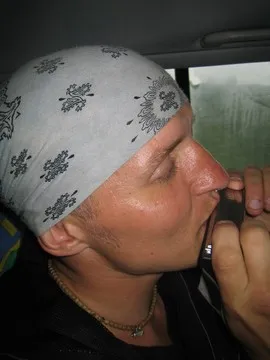 The second hitcher was called Denis and came from Saratov. He had two frontal golden teeth and headed for the Festival. He owned a guitar, two harmonicas and a big knife. He very well demonstrated his harmonica playing. He gave me two Japanese eating sticks and I presented him with the book of Krotov: ‘The practicing of free travel’.
On our way, we got two times a fine. I paid my share.
At Tjoletti I popped out. Denis did too. I did not understand it all together but according to me, the Belarusians thought him vexing and asked him 50 rouble. He decided to take the elektrichka from this spot. I doubted if I should go to the festival too. I do not like festivals at all and camping between 150.000 other people, I do not favor. I decided to look for a hotel, because at my address from the hospitality club I found nobody at home.
Together with Denis I walked tot the station. I supposed buses would go the city from this spot. However, that did not appear to be so. I said farewell to Denis like old friends. I walked back tot the road, where I found a minivan, which went tot the central region. In hotel Volga I booked a nice room for € 15,-, a friendly staff and an internet café around the corner.
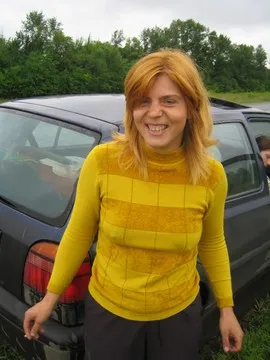
Grushinski Festival
This year the Grushinski Festival is held for the 32nd time. In 1965, the boy Valeri Grushinski drowned in the Volga when he tried to save the lives of children who had fallen in to the river. The children were rescued, but Valeri himself drowned. Grushinski was a student in air- and space technology who played the guitar very well and could marvelously sing.
To honor him his friends organized every year a meeting with singing and music. This developed into a major festival with sometimes more than 300.000 visitors. In the eighties, the communists forbade the festival.
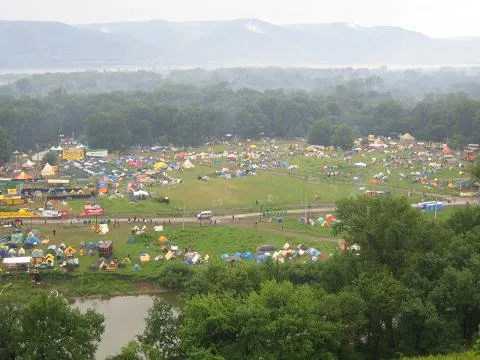
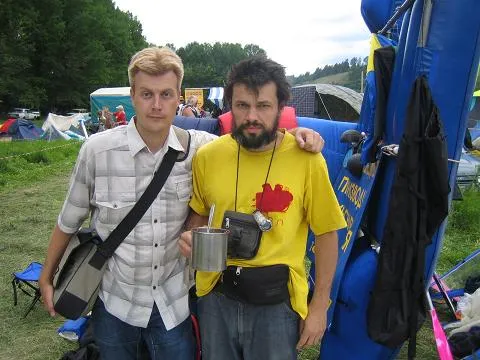 Everybody is sleeping in tents on the grounds, which are 2 by 5 m large. The grounds are divided into ‘lagers’. Punks, scouts, tolkinists, hippies, hitchhikers, soldiers, families, hoboes all have their own ‘lager’. Cooking is done by open fire and nature calls are done is some kind of latrines. People visiting the festival are drinking very large amounts of alcoholics.
After two days at the festival I have to say, not withstanding my reserves, it has become a real social adventure. I meet any number of people here, are being invited to their ‘lagers’ or I am being introduced via other people to more visitors. Sometimes four people at one time. I get tea, porridge, dried fish, beer, complete meals with vodka and we are taking pictures of each other.
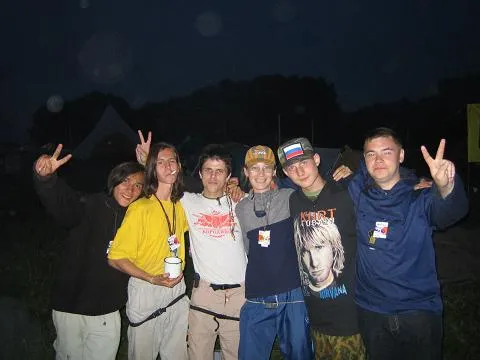 Even if I am alone beneath my shelter, someone is hastening to accompany me. The Russian slang people are talking is sometimes very difficult for me to understand. In addition, small talk I do not favor.
I acquainted Gulsum, with whom I will stay in Ufa. In her camp, one over enthusiastic Karina asked me to take me with her to Vladivostok. I needed not to think one nano second about this. My refusal was met with much misunderstanding. Evidently, she was held for a nice girl and one does not turn off such an offer.
Yesterday evening the big concert was given with a variety of artists. Everybody had gathered on a rather steep slope.
By the way, the internet does not cost me anything with one condition: I have to give a sturdy customer quote in English about the SAMTelekom, which makes this all possible.
Okay here it goes: I would like to thank SAMTelekom once more for the excellent service they provided me free on the Grushinski Festival! Thanks to them, I was able to continue the day tot daily reports of my trip. The speed of the connection is very impressive and the SAMTelekom employees were very helpful!
Day 7: Grushinski - Samara - Ufa
On Monday morning, I went with a fully loaded taxi van for a small amount tot Samara. I put my bag pack in the luggage locker of the station. An ultra modern building of mirrored glass en steel, with inside a spiral sloping passageway like the Guggenheim Museum in New York. The two centre of Samara looks European with small houses, narrow streets and even a pedestrian zone. The centre is that is way very busy with traffic jams. Here and there pre revolutionary houses are standing.
 There is a pleasant park with a beach at the Volga where I was loitering some time.
At the end of the afternoon, I went to my lodgings of which the owner had sent me some SMS’s. They were worried what kept me.
It was a household with one mother and a daughter of 16 years old, called Dasha. Mother was the owner of two bag shops and rather thriving. I ate delicious chicken, after that I bathed and
Washed all the dirt of the festival from body, toes and fingernails. I declined all kinds of excursions and visits to friends. Maybe impolite, but I went tot bed early, because I was very tired.
The next morning I said farewell at 8.00 o’clock. By some busses, I reached the road at 10. I found a good hitching spot behind a police post, where everyone was driving slowly.
Quickly two other sportive looking hitchhikers appeared with reflecting clothes. One of them was hitchhiking very aggressively and tried to halt cars with compelling movements. He succeeded rapidly. The three of us could ride with a police officer tot the through road, the M5, some 30 km further on. From that spot, it was still 480 km to Ufa.
When I arrived at the lift spot it was a coming and going of hitchhikers with hangovers from the Grushinski festival. Super hitchhiker Skazochnik came and went. The sportive hitchhikers and the local women were gone quickly. After 2 hours, only some wooly locals and I were still standing there. I was a little bit dejected and put on my raincoat to distinguish myself. A drunken man pestered me. He said he knew me from the festival. I did not know him. He asked for some money and I gave him 30 rubles.
 At last, a Chevrolet 4-wheel drive halted with a sales representative of the Russian branch of Van Nelle, the famous Dutch sweet factory. He drove quickly to Oktjabrsk, some 250 km further on. After a quarter of an hour, we had passed all the hitchhikers who I had seen this morning. They seemed to have accepted rides for short distances and now they stood to be vegetables on an unfavorable spot.
I talked very well with the driver who had once been on a working visit tot Amsterdam. He drove always on the roads between Kazan, Moscow, Samara, Ufa and Orenburg. This was his sales area.
He told me he had once seen a documentary about a hitchhiker who had been in Afghanistan and Africa. I showed him a photograph of Krotov and it was he, he had seen in the film.

The M5 became narrow and snaked through the hills of Tatarstan and Baskiria. I saw a lot of nodding donkeys, so this had to bee an oilfield. The bare hills, vast views, specs of wood and nice lakes reminded me of Ireland.
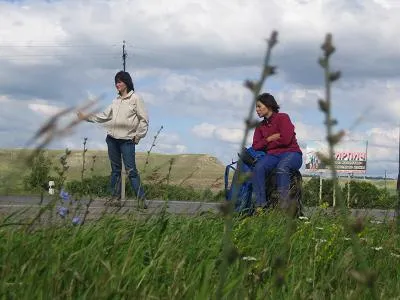 At the turn to Oktjabrsk we halted and when I got off Gulsum and his niece Dina came running to me. The too were hitchhiking back home and thought the car halted for them. Very funny of course when they saw me coming out of the car. I lay down at the shoulder and made photographs of the hitchhiking women, the pulling up of a car, they getting in and the competitive hikers clearing off
Then I took my turn and soon I could get in the back of an old and dirty former labor van. I could not see and speak the driver and co-driver. I even could not look ahead. 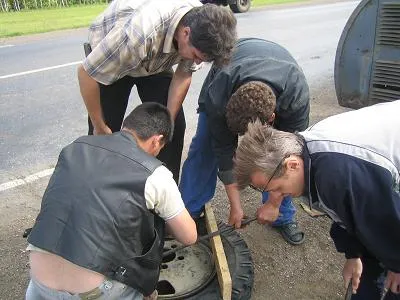 First, I felled a little bit uncomfortable, but after a short stop when they assisted somebody at the road who had a breakdown, the two men looked very friendly to me.
They were heading for Ufa and assisted people on the road who had a breakdown. They did it free. However, our speed slowed down by it. They too halted to let me take pictures of picturesque spots.
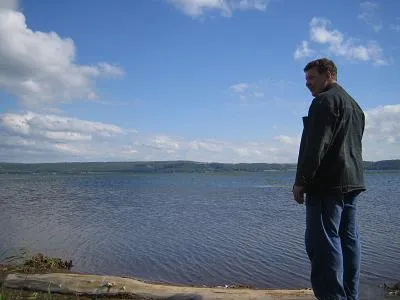 The road narrowed further and after three hours, I could pop out in Ufa. I was completely shaken up. Gulsum did not live far away and I soon found her home.
We ate delicious with her family. I acquainted her sister and friend who just returned from honeymoon to Europe and had taken thousands of pictures.
Day 8: Ufa - Chelyabinsk
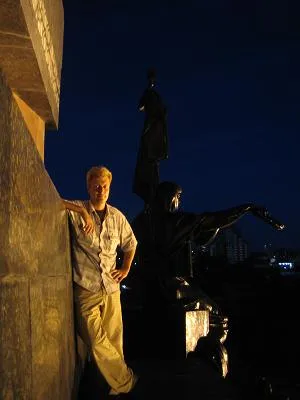 After a comfortable daytime in Ufa I walked in the evening through town with Gulsum. On a tiny bridge in a park, a rather drunken woman addressed us. She became a mother 4 weeks ago and tomorrow she had to register her daughter. It was about time to think of a name. She was beating her brains to find a name and she asked if we did not know a nice one. We mentioned a whole serial, but she criticized everyone. On a sudden moment, I mentioned the name of Petra and she liked it very much. She collected coins and I gave her some euro-coins after which the name Petra she loved much more. How it will end I shall never know, but I estimate it a good chance a new Petra has entered the world.
With Gulsum I drank tea and chatted about everything until deep into the night. I became much wiser about her live and her hitch hiking trips in Holland and Western Europe. Very interesting to learn how they look upon our country and society. She thought not much of our boring bourgeois and predicting way of life. Not withstanding the difficulties here people do not complain. It is not done to talk in everyday conversations about each other’s problems.
We too talked about the philosophy of hitchhiking and traveling, about emigration of Russians to the west and the connection between prosperity and happiness. Gulsum thought during Soviet times it was generally better; people were nicer against each other and there was more equality. She was not the first young Russian whom I met during my trip who told me this.
The next day I nevertheless rose early, said farewell to Gulsum and went by bus to the M5. When I arrived, there a bunch of locals stood hitchhiking there already with a police officer and two girls among them. The locals like to chat with tourists and standing close to you. Such a group diminishes greatly the chance getting a ride and I had to walk further onwards and again put my rain jacket on and put my backpack prominently besides the road.
That was successful and I got a ride in a Gazelle van, which transported me 30 km further on. The town of Ufa was still to be seen on the left hand side. Ufa is a vast town with 1.2 million inhabitants. After that, a couple gave me a lift. This is very unusual, because they rather stay together alone in their car. They brought me 100 km further on.
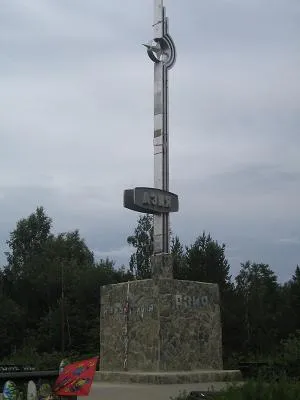 After waiting half an hour and some asking around, I got a ride in a Gazelle van from a silent Tartarian driver. After a several hours ride on the road which snaked thorough the Ural’summits’, I stood at a distance of 100 km from Chelyabinsk.
On the way, we passed the border between Europe and Asia. I received news about the ‘Terakt’ in London; however, no one here raised an eyebrow.
On our way we spotted the hitchhiking police officer with the girl from earlier that day, getting both off a lorry. My driver laughed: Ha-ha, he caught a whore!!’. He apparently thought the officer took a prostitute from the driver’s cabin and arrested her.
The last ride this day I again got from a driver in a Gazelle van, which brought me to the centre of Chelyabinsk. I phoned with Julia with whom I already e-mailed about the time I would arrive.
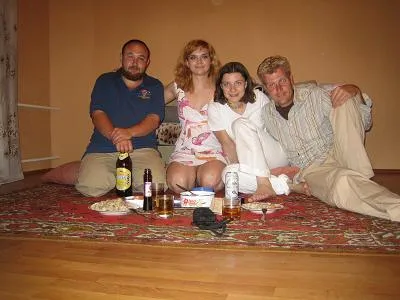 That evening I made a sight seeing tour in a Renault Twingo with Julia, Olya and two other Belarusian hitchhikers.
Chelyabinsk has been built in the sixties and was the centre of nuclear weapon technology and industry. Formerly a forbidden town for outsiders. Here and there one tries to erect places of interest like a church or a cinema and a shopping area is been set up. Moreover, it looks like a race between Russian towns, which one of them has the most beautiful, modern, and magnificent railway station. 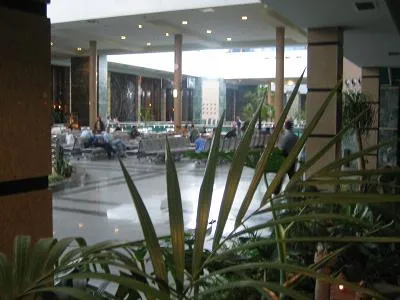 Samara Central looked already very impressive to me; however, the station here beats all. Everything is made of marble and malagyte, many sculptures inside, tropical gardens everywhere, luxurious waiting rooms, paintings and running water. Rather bizarre in this basic town.
In the neighborhood there seems to be one of the most polluted towns on earth, situated along an orange river.
Today it suddenly appeared to me I spent the night at the home of an other Julia than the one I had contacted long ago via Hospitality Club. The real Julia sent me an e-mail in which she worried what kept me. Oh dear, the names over here are not so distinctive and I myself am a little bit unorganized in my address keeping, which spreads over head, telephone, notice book, address book and the internet. I excused myself extensively. It was accepted with a glimmer.
I became very tired of Misha, the Belarusian hitchhiker. He owns a phenomenal memory for poems, anecdotes, proverbs and jokes, many jokes. He is talking continuously. Many people like hem for that, but I unfortunately do not understand only a little part of his Russian language skills. It saddened him and he did more and more his utmost to explain everything. I did more and more my utmost to understand him and that is why one moment I did not understand anything anymore.
I drank bottles with liters of beer and taught Olga how to juggle, which she learnt very quickly (with three balls).
Dag 9-10: Chelyabinsk - Novosibirsk
The saga continues. In 33 hours time I bridged the distance of 1500 km between Chelyabinsk to Novosibirsk, the M5 from start to finish.
Saturday July 10 I rose at ease and went with Julia to the home of Olga, where Misha, the Belarusian hitchhiker, was staying. Together the women rode us to the hitchhiking spot heading Toergan. We said farewell and started hitchhiking.
Rapidly I got a ride of a fellow in a Lada, who took me 80 km further on to a police station. There was very little traffic on the road; one car every four minutes. After some time a left hand driven Honda halted with Misha already in it. I could get in too and a serious man who knew a lot about the surroundings and the economical situation of the Urals was bringing us a very long way. It seems the watermark here was rising for some years and several villages already had been flooded. Many birch woods are dying too from this phenomenon, because they became rooted under water. We could see all this clearly. De vast woods with trees without leaves were spooky.
The man went fishing in Kazakhstan, some 50 km south. Some moment he had to turn right. We were left at an unfavorable spot because cars passed us rather fast. Misha stood behind and I 50 meters before him. It is not clear at all who profits from such a situation. Sometimes drivers warm up by the sight of the first hitchhiker and only halt at the second one. Drivers who always take hitchhikers of course halt at the first one.
Maybe it would have been more sensible to let Misha standing before me. He is of course more able to persuade the chauffeur to take the other hitchhiker too. Anyway, I got the first ride and told the driver that the other hitchhiker with the little beard further on was very funny, was originated from Minsk and knew many jokes. However, this did not do the trick. This driver obvisiously did not feel to have two hitchhikers in his spacious Honda. His name was Denis and told me most Russian did not like to work hard and that was all of our conversation. He dropped me at the turn to Kyrgan, where he was destined.
Almost immediately I got a ride from a gentle person, who was a teacher. He was on his way to visit his parents, who lived some 200 km further on, near the border with Kazakhstan. He complained about the worsened attitude of the Russian youth. We picked some time ‘glibniki’, a kind of wild strawberries, which are growing near the soil. This is the season when this berries are ripening and you could see many people pick them on many spots along the road.
The shortest route from Kyrgan to Omsk runs through a stretch of Kazakhstan. In Soviet times, when Kazakhstan still was a part of the Soviet Union, everyone just followed this road. Now nobody does anymore, because you have to wait at the border up to 7 hours. For me this route was no choice, for I did not have a visa for Kazakhstan. Through traffic now makes a detour, around Kazakhstan, heading in the direction of Omsk.
I was dropped off at the beginning of this detouring road. Almost immediately again I was picked up by a hunter in a UAZ van. Nature around us was very beautiful. We passed rolling steppe landscape with here and there a little lake. Everywhere I had a 360-degree view and could see everything kilometers far off without seeing any traces of human activity.
On the spot where I was dropped, at a petrol station behind an exit, some 80 km farther on, hardly any traffic was seen. I estimate one car every 5 till 7 minutes, which you could already see coming from a great distance. Rapidly I got a ride from a man in a Lada. He was the very friendly and cheery Kolja, who was 61 year old. He told me his son phoned him this morning who was standing with three flat tires at a fuel station along the M51. Junior had not told where the petrol station was exactly, so his dad bought tires, went heading Kyrgan and visited all the petrol stations along the itinerary. When he came on his son, he already had driven 250 km. When the tires were changed, a fourth one also flattened and dad again had to buy a tire somewhere. Now they were heading home and after a while junior came in sight, who slowly lurched with a heavy-laden minitruck to Ishim, where they lived.
Kolja had been an engine driver on subsequently steam- diesel and electrical trains. Engine drivers are retired at 55, because the work is heavy. He liked the diesel locomotives most. Driving an electrical engine was according to him very unhealthy because of the magnets in it. Of his former colleagues, who most part of their lives had driven steam trains, some still lived and one evenly was 80 yeas old. Many of his younger colleagues already had left or did not even see retirement. I asked Kolja what of the possibilities of hitchhiking in trains. This was strictly forbidden, he said earnestly. After that, he told of many events in which passengers were involved whom he took along in his engine.
I rode a long way with him. Some times we waited until we saw junior again. The last stretch of the road before Ishim, the road became very bad. Continuously we had to drive around potholes and bad stretches. When the sun was setting, we reached the turn to Ishim and I got off. It was 22.00 o’clock and according to Kolja, I could do better to come along with him to Ishim, where a cheap hotel was. I decided to continue hitchhiking for some time and spending the night in my tent. I said farewell to Kolja who warned me for ticks.
In the mean time dark had set in and I had put on my LED-headlights, which I got from a hitchhiker on the Grushinksi Festival and in Moscow. The passing locals sometimes looked at me in bewilderment. Through traffic was very rare. I received phone calls from Petra who had arrived safely at home, from my parents who went on holiday and a SMS from Misha who told me locals had invited him to spend the night with them. He was 100 km behind me.
When I was looking for a spot to pitch my tent suddenly a car with a couple in it halted and brought me 15 km onwards. They dropped me at the strategic spot where the road to Tyumen joined my road and there was far more traffic, especially many lorries.
Rapidly I got a ride to Omsk in a truck with a silent driver, who had a nice musical taste and he did not smoke. He navigated his lorry sturdy around the potholes. We never reached more speed than 50 km/h. I enjoyed the ride very much; not withstanding the dark, I had a good view, pleasant rock music from the seventies, a comfortable cabin (Scania), absolutely top.
The chauffeur offered me to get to sleep in the cabin but this is against the hitchhiking order: ‘Thou shall not sleep in the car.’ As the night wore on and he kept urging me, I began doubting this order and lay down. He soon did the same, for he could not keep open his eyes. I slept very well and when I awoke, we already were at Omsk. There was much traffic on Sunday, because of the day-trippers who went fishing, picking berries or mushrooms.
Omsk is a large western Siberian town with 1.5 million inhabitants. I did not enter the town. I only did some shopping at a fuel station. After three short rides, at 9.00 o’clock, I was at the start of the way to Novosibirsk, 680 km. east. This road had been entirely renovated in 1999 and was therefore in excellent condition. Traffic was about one car every three minutes.
Here I made a mistake, which would have cost me dearly. After my experiences in a Kamaz last year I decided to let pass the Kamazzen, unless the situation would become desperate. Maybe I was still sleepy or I was not on the lookout enough, I nevertheless stretched my arm at a slowly passing Kamaz and this one halted. Kamaz drivers are the friendliest. I hopped in and it appeared he went straight ahead to Novosibirsk.
Thirteen hours later, I got off in Novosibirsk. On our way seven times the police stopped us at which two times, they scrutinized my passport. Two times the motor stuck. The cabin had to be raised to repair an oil pipe with tape. After that, I had to clean sponge the driver. Because of the shaking of the Kamaz, it is not possible to read or write on the way. The vehicle does not have a radio, very stiff suspensions and the seat for the co-driver does not have a back and springs. The speedometer was broken, but I estimate our average speed was 50/60 km/h.
In short: a character building experience.
Day 11: Novosibirsk - Krasnoyarsk
In Novosibirsk, I met all kinds of people:
- Americans
- Daniel who already studied for some years in Groningen in the Netherlands and speaks Dutch well. His mother runs a Chinese restaurant in Novosibirsk.
- Lars, the Dutchman who is working for Royal Haskoning and is toughly negotiating with locals.
- A group of Belgian youth who asked me directions to the railway station. They want to educate Russians about ecology.
- My friend Serge, the naychni bomz (the academic wanderer) who
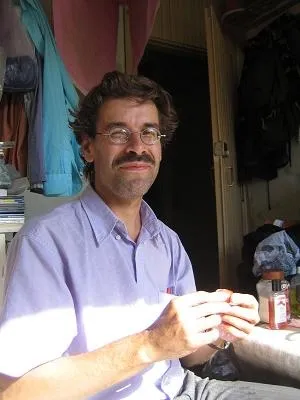 visited me in May during his trip through the Netherlands. He lives in Akademgorodok, the scientific township in the neighborhood of Novosibirsk.
 - Andrej and his girlfriend Tanja. At their home, I spent the night. Andrej is a heroic but modest hitchhiker. He already visited many parts of Western Europe, China, Laos and Thailand.
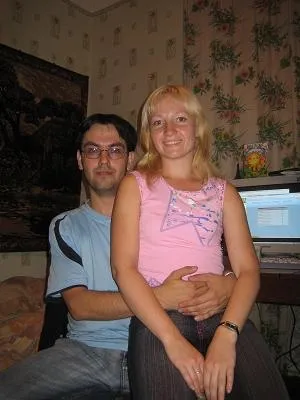 He did this without spending one penny on sleeping or other things. He walked from Cannes to Nice in France and too walked parts of the Krim coastline. He also is a fine photographer and I admired many nice pictures. On one of this, you can see an improvised place to sleep in the junction of the highways A2-A4 south of Amsterdam.
Tuesday morning I went by elektrischka from Andrej’s home to the town centre of Novosibirsk, subsequently by bus 1189 to the first police station at the M53, the road from Novosibirsk to Irkutsk. This runs via Kemerovo and Krasnoyarsk.
There I got quickly my first lift from a young man in a sportive Lada, which he had patched up himself. Yellow hubcaps, sturdy wipers and spoilers. Only the window at the back was missing. With him, I vastly raced to the next police station.
There I acquainted for the first time the Siberian midget. People who have visited Scotland know what midgets are. Little swarming flying insects especially during showers and dusk. Contrary to mosquitoes, who painlessly drill a little hole in your skin before sucking blood, the mighty midget painfully tears open the skin before drinking your blood.
I did not have time to search for my repellent, for I got a ride from a pilot on his way to Tomsk. I rode with him to the exit to Tomsk. On our way, we still picked up a hitchhiking soldier.
The pilot was flying little planes of 20 passengers to Moscow or Vladivostok. Eager to hear sensational stories I asked him for his experiences with near crashes. He told me that once he was flying tot Moscow with a three-engine plane when a storm hit them. One motor failed and when he prepared for an emergency landing at Novosibirsk, the second motor failed too. He managed to land safely but many passengers had fouled the chairs.
I was set down at a parking place with many trucks and a café. I asked some Belarusian truckers for a lift in the direction of Krasnoyarsk. They did not turn me down, but for the time being they did not intend driving already.
 Then I got a ride in a fast Lada to Kemerovo. The driver lived there and told much about the mining town. Kemerovo is the centre of the Kuzabass, the region where 85% of Russian coal is quarried. Besides that, it is exported to the rest of the world, especially China. A long time the situation was very bad, because Moscow did not pay the miners’salaries anymore. Now the tide was turning. Moscow paid again and many mines are privatized. The dilapidation is still to be seen in town, but here are also signs of growth of prosperity. Many buildings are being fixed, the roads around the city are in good condition, almost like in The Netherlands and are excellently signposted. Through the entire town centre traffic was jamming, which points to many cars.
In the town centre, I was dropped off and I took bus 10 to the other side of the vast city. The bus driver told me to walk through the woods to reach the road again. That was correct.
At the police station on that spot, there was a wayside restaurant. Until now, I saw along the way I came, all kinds of cafés and little restaurants near the road, from very luxurious to basic housed in a caravan or many times in a site hut.
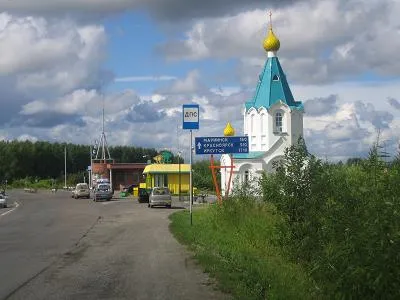 A group of students from Kemerovo discovered a hole in the market here and started a chain so-called Dorozhniks. They are very well recognized by their logo, green-yellow colors and with fixed prizes and quality. Inside there are some big refrigerators and an array of magnetrons. A roll is warmed up in one minute and does cost € 1.50. One can order tea, coffee and lemonade.
From the hitchhiking spot, I saw that many visitors of the restaurant were no travelers at all, but came from downtown to Dorozhnik to have a bite and a drink. The effect of the McDrive.
In the mean time, it had become 18.00 o’clock and I still had 420 km to go to Krasnoyarsk. The hitchhiking spot was excellent. Unfortunately, the police sent me away. They told me this was no parking place for vehicles, but their working space. 100 meter onwards, cars drove much faster. As luck would have it, the Belarusian lorries stopped, which I earlier that day approached. With much squeaking brakes they halted their trucks to take me along. With them, I rode all the way to Krasnoyarsk thorough marvelous hilly and very unpopulated area. Gradually the deciduous woods changed into pinewoods, the taiga.
The drivers transported a metal device from Germany tot the underground city of Zelensogorsk, some miles behind Krasnoyarsk, where two nuclear reactors are producing plutonium for bombs. They had to stop often and make telephone calls. They still had no license to enter the town. In addition, the load was sliding and two times this had to be lashed up again.
At 2.30 o’clock, in the middle of night, we arrived at a place with a motel where truckers could spend the night, 2 km. before Krasnoyarsk. There I rented a little room and went to sleep.
Krasnoyarsk
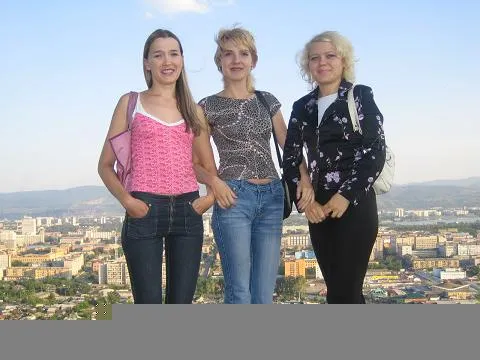
Early in the morning I put my bag pack in a locker in the railway station. Then I spent almost all day to get a new USB-cable, which succeeded. In the evening, I met Elena, an acquaintance of Gulsum and Ufa. Like Gulsum, she had been trained at the Caterpillar factory in Belgium and now had a job for Caterpillar in Krasnoyarsk. She had arranged a sightseeing tour through the city in the company car of her girlfriend Tanya. We went to two viewpoints on the mountains surrounding Krasnoyarsk. I stayed at Sveta’s, an other girlfriend of Elena. Sveta was full of her career. She wanted to become a manager at an interesting company as soon as possible.
Next morning it turned out the Belarusian hitchhiker Misha had arrived in Krasnoyarsk too. He invited me to visit together the ‘Stolbi’ near Krasnoyarsk. These are big basaltic formations from 40 to 80 meters high, situated in the woods.
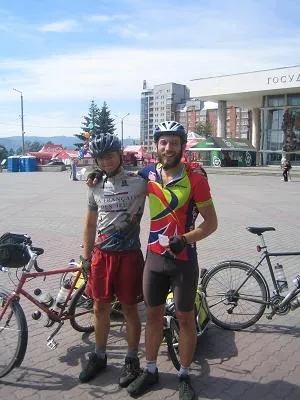 When I sat waiting for him two western bikers passed and approached me. They were Lewis & Clark from Bath, UK, who were on their way to Mongolia by bike. Very heroic indeed. They were so tired they had to think some moments about how they were called. The rides were very tough and especially the Siberian midgets were no joy. It will become still more difficult as they travel farther east where the roads are worse.
Later on, I met a Canadian who was biking from Jakutsk to Europe. He cycled in the direction of a better infrastructure. G&C asked me what the meaning was of the word ‘Malatsi’. This they heard many times from locals. I explained this was a compliment and means something like ‘brave lads’. I gave them my encephalitis antidote pills, which I bought in Novosibirsk. They will fear ticks more than I will, I think.
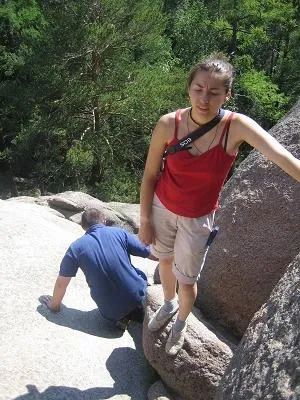 With Misha, Marina and Andrej (the other hitchhikers) we were occupied the whole day reaching, climbing and descending the Stolbi. Nice walk through the woods and the rocks were imposing. It was difficult to climb and I was very careful. Thoughts that it would be very ridiculous to make a fall here from the rocks after hitchhiking 6500 km. haunted me.
Misha talked again the whole day and entranced everyone -except me- with his jokes, songs and poems. Therefore, they attempted to impart me with the high beauties of the Russian language and again it tired me very much.
For that evening, I had not arranged a sleeping place yet and I experienced how the average Russian hitchhikers manage such a situation. In some Russian towns, there are spots where young ones are hanging about, the so-called ‘tusofka’s’. In Krasnoyarsk, the tusofska is near the toyshop.
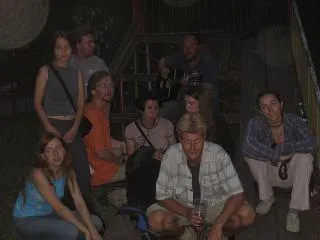 We went there and approached some youngsters. The guitars came out, songs were to be heard and we drank beer. Swiftly a person called Dima offered me a sleeping place. Dima told me how I could travel east free by the Baikal Amoers Railway (BAM).
Three police officers had a look and my visa and passport were ok.
I acquainted some girls from Irkutsk, who were heading for Moscow and I met Nikita from Magnitigorsk. With him, I already had extensively communicated in the Netherlands via the internet and we intended to lift together from the Urals to Baikal. However, this was off, because he met a girl who liked to go with him.
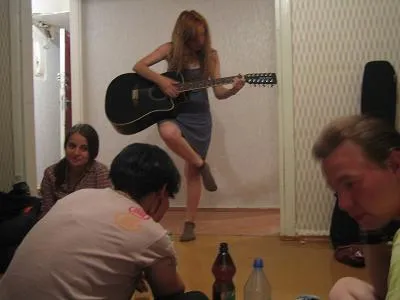 Anyway, it was very enjoyable and after much fuss, we reached our sleeping place, the vpiska. That night nine people would sleep there in this one-room apartment with mat against mat. At first, we had the usual drinks and songs. There also was a bloke from the farthest northern place of Russia. He only traveled with a guitar case. He slept on the floor without sleeping bag or mat and every evening drank so much that he did not miss this discomfort. He performed an imposing concert of throat singing.
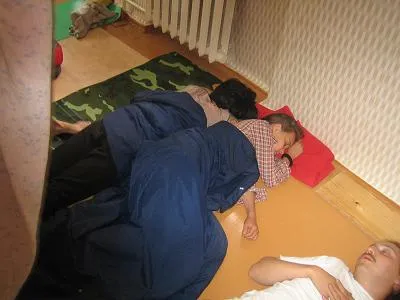 It was very late when I fell asleep. The host was very drunk and kept everybody awake. He continually crawled over everyone in search for more vodka.
Because of all activities in the past days, I was not able to wash my clothes and I was not well equipped for the remains of my trip. That is why I decided to stay another day and have a restful sleep in a hotel. I have much respect for the Russian hitchhikers who are traveling without bank – or credit cards.
Day 12: Krasnoyarsk - Taishet
I raised early (6 o’clock) and took a bus to the Krasnets factory. From there I went by marshrutka tot Berezovka, some kilometers further on. There should be a DPS police station, what is a good spot for hitchhiking but I could not find it. I decided to start hitchhiking at once. Quickly a Russian jeep halted and this could transport me to an other spot further onwards at a little café. After a cup of coffee, I immediately could ride with the first trucker I approached. His name was Kolja and he was on his way with an empty lorry to collect wood in Kransk, some 100 km onwards. He was enjoyable speaking to and he was glad to be able taking me further onwards. He asked me nineteen tot the dozen about the Netherlands and was very interested in our drug politics. He was 28, married and divorced again, father of the 8 years old Olyka. Just before Kransk, he turned off the road and I got out.
Almost immediately, I could continue my way with a local bus into the town centre of Kransk. In the centre at the bus stop, I met the very charming Katya from Moscow. She stayed the summer time at her grandmother’s and she said she was bored stiff in this provincial town. She was heading my direction and some time later, we reached the spot where according to the encyclopedia a police station had tot be. This one had disappeared. I asked for fun Katya if she liked to go with me to Baikal. After some thinking, she rejected my proposal in a straight way. True enough she assisted me hitchhiking. As a reward, she took some bites from my ice-cream. A car halted, which went 30 km further on. She popped out after 500 meters to get in a different car with acquaintances that waited for her. I wished here an easy life.
I drove further on with Andrej, a look-a-like of Al Pacino. He put me through a crossfire of questions and concluded I was an o.k. fellow. He did not understand why it was so funny to travel like this but also did not object to it. He was a representative of an alcohol trade. He drove for his job in a Lada but at home, he owned a BMW 500 to pick up the girls at night. He warned me to be careful and calculated that my salary had to be twenty times higher than that of the locals.
On the spot where he dropped me there was hardly any traffic, however two unmanned trucks stood there with their noses heading in the good direction. When the drivers returned from the café, I immediately asked if they would take me along. They had still to fix their cars, but after that, it was: let’s go!
I took a seat in the spacious and most beautiful truck I ever rode in. An American Eagle (General Motors), rather old but with a cabin size in standing height.
Driver Igor was an o.k. chap. As far as I could observe he had an entire golden set of teeth. He lived in Barnayl and drove two times every month to Irkutsk laden with sunflower pits.
The road was in good shape for a little while but after that came the worst parts I had come across until now. The asphalt just disappeared and stretches of real gruntovka followed, existing of bumping ground and gravel road. The truck drove at a footpace over all potholes and bumps. Rammstein performed.
According to Igor the civilized world ended here (here again, I thought). We passed all kinds of impoverished villages. Igor told me he could not quietly spend the night here without being pestered by alcoholic unemployed. Real bandits did not live here anymore for some time, he told.. Here only lived according to him ex-prisoners and exiles with their offspring. That is the case in entire Siberia (and Australia).
De M53 regularly crossed the Trans Siberian Railway. In the neighborhood of Taishet the road condition increased. In Taishet itself, the asphalt had disappeared all together again. I doubted if I should get out or not. I could have stayed put and thus arrive the next day in Irkutsk, however, the idea of traveling by BAM had stuck in my head in the mean time.
I got off and together wit a papirossie smoking old fellow I reached the railway station by bus and taxi for eight rubles. There again started a period of doubtfulness annex decision making. I was literally able to go in two directions.
1: Back to the road and hitchhiking heading for Irkutsk, Ulan, Ude and Chita, to go by Trans Siberian Railway to Xabarovsk and hitchhiking further onwards to Vladivostok.
- ✅ Maybe somewhat faster.
- ✅ Had already arranged a sleeping place in Irkutsk.
- ✅ Camp with known hitchhikers at Irkutsk at the Baikal Lake.
- ❌ Beaten track.
- ❌ Camp with hitchhikers.
- ❌ No BAM
- ❌ Long hitchhiking trip ahead with much grutkova.
2: Going further by BAM, the alternative Trans Siberian Railway, 3000 km through the taiga north of Baikal to Komsomolsk, there further onwards to Xabarovsk and hitchhiking tot Vladivostok.
- ✅ I travel by BAM and see the entire railway route.
- ✅ Off the beaten track.
- ✅ Chance to lift with trains.
- ❌ Insecure: are there really trains running? How many? How fast?
- ❌ No real hitchhiking anymore.
I choose for option 2.
Lifting with locomotives seems very well possible here; however, I decided to pay neatly my fare for the first stretch to Severobaikalsk (€ 15 for 24 hours traveling 1000 km.). To hitch a ride with trains is a completely new phenomenon for me, and the station of Taishet, however many freight trains halt their, is well guarded. My train will leave only tomorrow, but the railway station has good facilities. The facilities such as a luxurious waiting room with bed and showers were however fully booked, therefore I unrolled my mat in the waiting room and took a nice nap.
Day 13: Taishet - Severobaikalsk
When my telephone alarm woke me up, my train stood waiting already. I owned a platskartny for carriages without compartments but they happen to have sleeping berths. They are a kind of riding barracks, quite comfortable, unless you like privacy.
In the train, I heard people speak a different language. They were five Azerbaydzaskaya’s on their way to Bratsk, where fellow fellow citizen were living and working. They themselves also went to work there. Azerbaydzaskaya was a good country they told me, where you could live very well, unless you had a job, and they were very scarce. Azerbaydzaskayan’s look very well like Turks and the words, which I could dig up from my little Turkish vocabulary, they all knew. They themselves speak a kind of country dialect, not so nice to hear as refined Turkish.
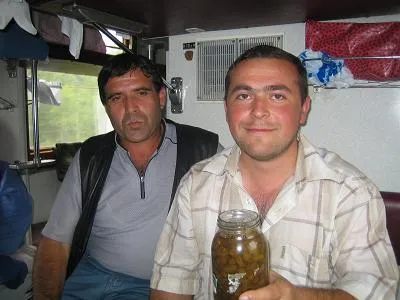 Two of them also spoke Russian and I had a nice chat with them. They liked to visit the Netherlands once, especially when I told them it is in the neighborhood of Germany. They knew you could go there uninterrupted and submit youself to the police. Then you would get accommodation and DM 500,- each month and you did not have to work for this.
I vainly tried to make some nuances to this story of Walhalla. I gave them my phone number. I was treated to coffee, tea and jam and when they got off the train, they said: We will see each other! Who knows?
The temporarily switchover to the railway pleased me very much after that much hitchhiking. Besides the fact that Severobaikals is not to reach in a humanly way by car, going by train has its advantages (duh :).). You can go to sleep well, tea and coffee are in reach thanks to the samovar. At 16.00 o’clock, I finally could break into my dragged along bags cup-a-soup (asparagus-flavor). These are tiny bags with powder and adding hot water to it t turns this into soup.
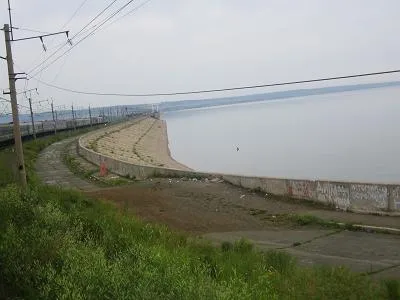 The first some hundreds kilometers of the railway from Taishet to Ysk-Kyt do not officially belong tot the BAM. This track was built in the fifties. On our way, we passed Bratsk, where the railway runs over the flood-control dam in the river Angara. I estimate the length of the dam about 7 to 12 kilometers. The area around Bratsk looks very industrialized. After Bratsk the stops decreased, the carriage was almost empty now. The landscape became rougher and mountainous and the first tunnels appeared. The weather was grey and rainy. Mist was hanging low between the mountains. At the station of Lena, I had a shoarma roll and went asleep.
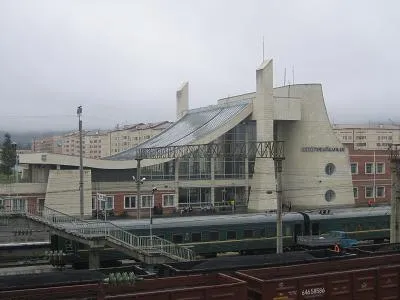
Day 14: Severobaikalsk - Tunda
July 19. In the morning I found out it was Tuesday instead of Monday, which I had expected. The fortunate effect was I was able to visit the history museum before I took the train for Tunda. Together with Michael, I walked there. Michael was my 49- year old roommate from the hotel ‘House on the Baikal’. He came from Irkutsk and was an IT-teacher. He visited a conference here with colleagues from the entire former USSR. The last evening we had a little drinking session with each other, dictated by a very drunken Ukrainian professor.
In the museum, a friendly burjatic lady guided us. She told many interesting things about the 4000 km long BAM- railway, the severe conditions during the construction, the many tunnels and bridges and the six alternative routes which only existed on the drawing table.
Taishet on the Trans Siberian Railway is the starting point of the Baikal Amoer zeleshno dorozhni Magistral (BAM) and ends in Sovietsk Gavan at the Pacific Ocean after 4000 km, 3000 bridges and many tunnels.
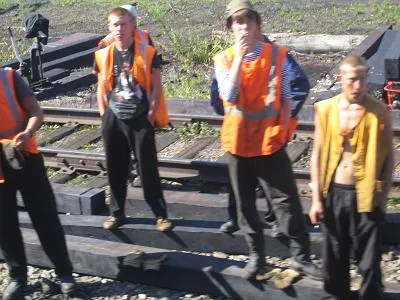 The longest tunnel is 15 km and cutting out lasted 5 years. When the job almost was done the tunnel was flooded and only with help from an American company, the work was finished. The burjatic lady told us this in a low voice. In 1984, the first train drove from Taishet to the Pacific. There still is much discussion about the real reason of building this railway. From economical viewpoint, it is a complete irresponsible investment. From strategically viewpoint, as an alternative for the Trans Siberian Railway in case of war, the railway looks rather worthless to me. With modern weaponry, the railway is made useless in no time. 3000 bridges for choosing.
The real reason for building was, according to Michael, the wish of the party bosses to breathe new life into the washed out Soviet State of the Seventies with a big enterprise. To no avail, the communism does not exist anymore, but the railway is certainly there, however only one passenger train a day is riding on some stretches and a few freight trains.
By an error with time, I almost missed the train. Time on station clocks, timetables and tickets in Russia are given in Moscow time. This is done to make matters easier, for computerization, not for the people. My train departed 8.30 Moscow time. Here it was Moscow time plus 6 hours, but in the internet cafe where I synchronized my mobile phone, for some reason it was Moscow time plus 5 hours.
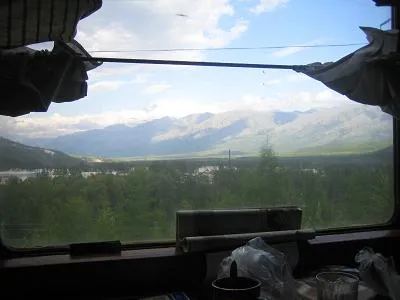 All in a sweat, I seated myself in the platskarny wagon (the riding barracks) and acquainted Jan and Artem Liu. They were fraternal twins with a Korean grandfather from paternal side. They both studied in Novosibirsk and were heading home in Niugri, a town in Sacha, the biggest and most unpopulated regional republic of Russia with the capital Jarkutsk.
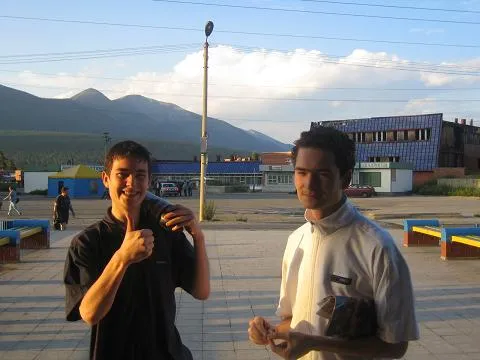 They were nice chaps, but difficult to understand. Their mouths hardly opened when they were talking. In the evening I bought some beer and later on at the station in Taskimo more beer and Bulgarian red wine. The boys tasted Dutch coin-licorice, listened to music from my MP3-player and we juggled as far as this was possible in a moving train.
That night I farted quite loudly. The next morning there were no complaints from the fellow travelers and Jan and Artem even claimed they had not heared anything. I did much leaning from the window to admire nature with high snowy summits which we rode by. Hundreds of kilometers there was no living soul to be seen. The BAM area is so unpopulated that there are no curtains in the toilet windows.
Dag 15: Tunda - Belogorsk
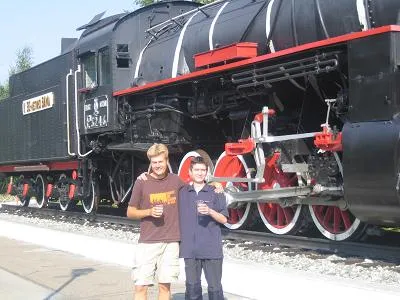 July 20 I arrived at Tunda in the afternoon and got off the train. Jan and Artem had to travel another 6 hours to their hometown, but the train stayed here for two hours. This offered the opportunity to a sumptuously farewell. We drank another two 2-liter bottles beer on the square before the station. Artem caught a big flying insect and demonstrated a joke from his childhood: he hung the beetle in a fold of his t-shirt, into which
 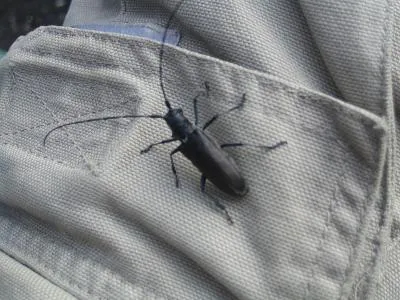 the little creature set his clapping jaws. Artem jerked quickly at the abdomen and this left a decorative brooch, shaped as a beetle head with long feelers on his t-shirt. The boys invited me again to go with them, I liked this idea but time was short and at times, I was beginning to feel homesick.
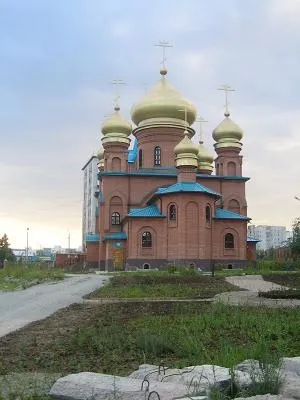 In Tunda I again had some options: to wait 23 hours for the train to Komsomolsk at Amur, going further on the BAM heading east or going by train to Chabarovks in about 5 hours time. The idea to catch a lift by train was still in my head and some freight trains stood on the tracks. However, when I calmly walked that side some police men immediately called me back. They were very friendly and after a short chat, we said fare well by handshaking. Later on I again talked to other police officers at the station and they too told me hitchhiking by train was strictly forbidden (but obviously it existed).
I did not like spending 23 hours in town; however, it is known as the capital of the BAM, it does not have that many places of interest. I bought a ticket for Belogorsk, a town at the Trans Siberian Express, where to my knowledge the motorway was in normally condition again. The tickets for the compartment and platskarny were sold out. There still were seats in the so-called Obshe carriage, the lowest class that only is in use in poor areas. I did not have much choice and I was ready for a new experience. So I bought a ticket for Belogorsk for € 10,-.
That afternoon and evening, I wandered through Tunda. Workers from Moscow have built Tunda and this can be seen in architecture and street names. Prices of products were comparable to Moscow prices. I looked for an internet connection. To find this it is the best, as my experience shows, to approach a young immaculately dressed intelligent looking woman. They always told me immediately that the internet was available in the library the next morning at eight. I could not wait for this and I supposed a massive crowd of women would be ahead of me then.
When I was waiting at the station, I met a group of Muscovites youths who were making a sponsored trip around the world. They were heading for Kamschatka and from there by plane to Canada. They got worried faces when I figured them the prices of cigarettes and beer. When I conjured up my digicam I found myself sudden in an igloo of heads. And in a crossfire of questions, I played the slideshow.
That same evening my experience in the obshe carriage began. I already had been warned to get in quickly, but a massive crowd was ahead of me, with at the head a group of yelling gypsy women who with their standard outfit, a little child in their arms, forced their way up front. I was at the back of the queue for tickets control and for getting in, when I saw three carriages ahead standing the locomotive and decided to prove my luck there. The locomotive drove away, some carriages were coupled and uncoupled, but after that was done, the locomotive pulled up. A local man estimated I stood good chances and put a good word for me at the engine driver. This one remained adamant and I beat my retreat. The provodnik asked me when I entered the train, if I knew what I was up to. No, I said. He advised me to be on the alert.
The obshe (the communal) carriage is an ordinary platskartny carriage with this difference that there are no booked seats and no bed linen being offered. There is no maximum to the amount of passengers. The fact that nobody has his own seat gives a little uncomfortable atmosphere. To get up for only a short time gives the risk your seat is occupied by somebody else. For me, as the last entered passenger, there only was a seat available. Facing me was Konstantin (Kolja), a man with a bandaged arm and constantly closing his eyes from sleepiness. Together we played some games of Nardi, the Russian variant of Backgammon; he easily beat me. When he went away to smoke a cigarette, a fat man took his place, who immediately fell asleep and was snoring when Kolja came back. Kolja looked sad for a moment and took uncomplaining the remaining end of the bench.
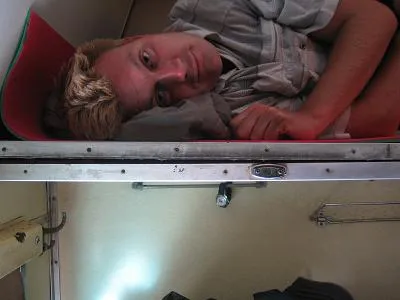 Instead of many Russians, I do not sleep very well in a sitting position and I decided to lie down on the third layer. This is the luggage rack on top of the uttermost bed. It gave me some hard climbing, shoveling luggage and sleeping bag, but at last, I could lie down and fell asleep.
The next morning my first thought was to get out at the first station, but one gets accustomed to everything, also to the obshe carriage. Because many people got off, I could have a better seat. 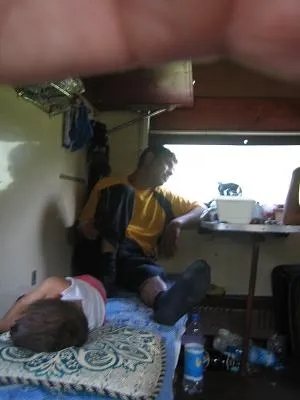 All in all the people were o.k. in the obshe. Even the gypsies were nice and it was a moving sight how they were playing with their children. There also was a group of deaf people, of whom I saw much in his area. They walk in semicircle on the street for understanding each other good. I had a nice talk with a woman who came to sit opposite me. She told me that the motorway from Chita tot Blagoveshenk is upgraded now and will be newly constructed at places where no road is at all. In popular speech, it is called the ‘federalka’.
In the afternoon, at the end of a hot day, we reached Belogorsk. I got off the train, had a mug of nasty kvas and found the only hotel in this rumbling, poor and dusty town. For 600 rubles (€ 18,-) I was given a suite with three rooms and a balcony, but there was no warm water. The attendant even asked if I thought it convenient and if I was able to pay.
I was just in the room when someone was knocking on the door and a little fellow in civilian clothes asked for my passport. He showed a pass, which had to show he was a police agent. I invited him into my suite and he scrutinized everything. Everything was o.k., but I had to register at the hotel absolutely, so I would not have trouble when I continued my journey. The attendant was not able to register me, did not have the right stamps, but told me in detail where I could find the police station, where I could register.
During falling asleep I decided to make a last attempt tomorrow to hitchhike by train and otherwise to look for the highway and lift for a ride.
Day 16: Belogorsk - Chabarovsk
July 22. After having breakfast in the morning, I went to the police station at the edge of town. There assembled in front of the room for passport registration a disorderly crowd in a scorching hot narrow passage. I doubted for a moment to use my foreigner’s state to be next, but after a little hesitation, I decided to forget the whole registration and take the risk. I went back tot the hotel and with my rucksack, I walked to the deserted railway station. Two freight trains stood waiting with the locomotives heading in the right direction: to the east.
While I walked across the tracks to the locomotives, ignoring a prohibition sign, the first train drove off. The other one with tens of tankwaggons was still there and I could ask my question. The engine driver looked joyfully surprised, consulted somebody, but already quickly opened up the little door and I was guided tot my seat at the other side of the long symmetrical locomotive. Some men sitting along the tracks advised the engine driver to ask for my passport, but he brushed this aside. The driver walked to the front of the engine and advised me not to touch the buttons and handles.
The train soon started riding and I feasted a little to honor this great victory. Quickly I sent some joyful Sms’s before I could not reach anybody anymore by phone.
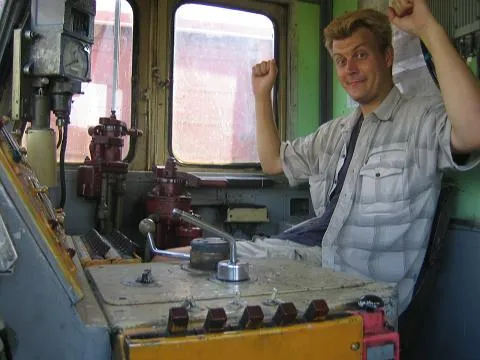 A long sit of 25 hours followed, in which we covered the 500 km to Chabarovsk. Nature was very beautiful and mountains appeared again. Half way the ride, the drivers’ team was relieved by a new command. The first two drivers I presented with my Delft’s blue wooden shoes and after a short introduction with the new drivers’ team, they allowed me to stay.
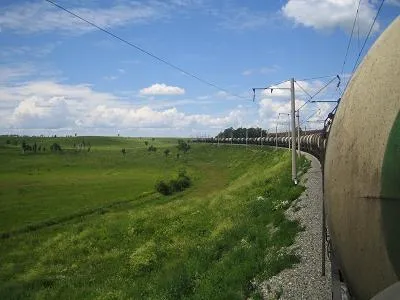 The train rode long stretches at walking pace, not faster than 10 km/h and sometimes suddenly came to a standstill. Towards evening the driver came to light a lamp in my cabin. At two o’clock in the middle of the night, the train was uncoupled and a new one was coupled to the engine. Again these were tankwaggons and after many complicated shunting, we rode further heading east through the Jewish autonomous regional republic. During shunting, my cabin was in use too, and I could see how operating a train is done, but I did not grasp it. It was clear that the job of an engine driver too took a lot of paperwork. All movements of the locomotive were registrated at a tachometer and all maneuvers were written down by hand in a thick logbook.
During some time, I intended to visit Birobidzhan, the capital of the Jewish autonomous republic, but the train roared past and getting off was no choice.
Apart from a low haze above the fields, the night was clear and the big yellow rising full moon was marvelous. Darkness sometimes lightened up by shooting sparks from the overhead wire. I did some catnaps in my little seat while hanging my head half way from the window, resting on my arms.
In the morning at 7.30, we were 30 km distant from Khabarovsk and the wagons were uncoupled. As a single locomotive, we should drive to Khabarovsk. Single locomotives do not appear to have much priority and we stood waiting for 3 hours on a sidetrack at a little station near Chabarovsk. Elektrichkas, freight trains and passenger trains passed us left and right.
At 11, we pulled into the station after we rode over a long bridge across the river Amur. We had reached our destiny. Once again, I presented two Delft blue wooden shoes and said fare well. I took a last shot of my locomotive and with a great sense of satisfaction I drank one of the most delicious beers of my whole life opposite the railway station, underneath the statue of Khabarovsk, the founder and namer of this city, 8400 km to the east of Moscow.
Chabarovsk
July 24. Chabarovsk was a pleasant surprise after passing all those arid villages and barren towns during the last 3000 km since I was in Krasnoyarsk. The town is clearly joining the economical revival of the Pacific Rim and the town centre makes a significant wealthy impression. Beautiful restored large buildings, nice restaurants, shops with designer wear, many statues and many right hand driven cars.
The town takes up some hills at the broad river Amur. The central boulevard is about 3 km in length and ends at the river, where one can descend beautiful staircases tot a nice little beach, where you can see left and right the promenades along the river. During my visit, the weather was very warm and humid with temperatures about 30 + with now and then a heavy shower. This caused some problems, because I had not yet experienced such temperatures during my trip. I swam in the Amur, which has clearly polluted water.
In the air-conditioned internet cafe, I met two boys of 20 years old, Kolja and Valentin. It lasted some time before I knew them for what they were. At the first introduction they looked quite normal (from the Dutch frame of reference), but later on it appeared they were the type of blokes, of whom there are too much around to my taste in Russia. First, they are very friendly and show a nearly aggressive kind of hospitality, not withstanding the fact; they hardly are able to offer something to a guest. Further, a high degree of opportunism, birdbrains and lack of self-knowledge and sense of reality marks their behavior.
The boys were very enthusiastic about meeting a Russian-speaking foreigner who also was willing to some conversation. They invited me to go that evening to a, according to them, rather trendy and stylishly discotheque to present me with an unforgettable remembrance of Chabarovsk. The whole day I had wandered around town by myself and I needed a little company. They were pleased I agreed, by which I of course forfeited the right to complain about the subsequent events.
We made an appointment for 11 at night. They would change firstly at home, wash and shave them selves. They liked to have a look at my hotel room, but the attendant did not allow them to take the elevator.
At the appointed time I saw nothing had changed their appearance, except their shirts were not buttoned up, under which one could see their exposed skin. Their hair still was greasy, but Valentin changed his sports shoes for mules. Immediately a taxi was hailed, which took us for the ridiculous amount of 150 rubles one kilometer further on. ‘Is it not expensive Peter?’, the boys noticed with some proud. At the entrance of the discotheque, it appeared they just could pay the entrance fee and more over Valentin was not admitted in his mules. After much fuss with the doorkeeper and arguing I was a foreigner, at last he succeeded in being admitted in his mules. Inside it was almost deserted and more than 30 people should not be there that evening. The music was nice an after some vodka I amused myself on the dance floor. The boys tried in a clumsy way tot pick up a girl for me or to arrange someone for themselves, at which they used me as an attribute for their toughness.
Nothing came of it. Anyhow, my intentions were not heading that way. It appeared that the hot-blooded blokes with their greedy appearances were a welcome barrier between the willing ogle women and me. To my amusement, they continuously assured me that everything would be oke. At 3 o’clock, I decided to move on, considering my last hitchhiking trip, which awaited me in some hours.
My ‘assistants’ argued a lot, but when I really left, they quickly joined me in the taxi. Instead of heading for the hotel, they told the driver to go to a sauna. I did not like this at all. However, they insisted I should take part in this marvelous Russian experience. When we arrived, it appeared they had some money left for the entrance fee and we sweated some time, which was not uncomfortable. For further enterprises they had not any money left and my liking was entirely gone. When I got enough of it, I exerted a sudden sleepiness and an attack of drunkenness. This satisfied the men, they again jumped into their assistance role and they ordered a taxi to my hotel. At arriving there, the doorkeeper again consistently halted my companions, and I could go to sleep.
The next morning when I was still heavily snoring, at 8.30 Valentin with a loud voice broke into my room. I was unpleasantly surprised by this visit, because of my hang overly morning mood. I showed him this with several remarks. I do really believe it did not get into him, I did not like his presence. He looked completely innocent and still thought he was the ultimate assistant. Without him, I would be hopelessly lost in town.
The previous day I already repeatedly had made clear that I wanted to go to the motorway as early as possible. Unfortunately, I had at first to cash some money, because the last evening the most of it had been squandered. Valentin wanted to hail a cab at my expenses and was surprised I had no money left. ‘Don’t you know who paid everything last night, Valentin?’, I asked. ‘And why do you think I am looking now for a cash point?’ ‘Oh yes, yes, of course.‘
He undisturbed got ahead with his reasoning power: ‘Peter, how does the cash point knows that it has to give you Russian money, while in your card there are euros? ‘Peter, when you take a picture with your digicam, is this one immediately set on the internet?’
After I told him where the road to Vladivostok had its beginning in his town (knowledge from the Encyclopedia) he showed truly guiding skills by asking many questions, a long walk, unnecessary many bus rides and detours to take me to the right spot, while he kept assuring me everything would be oke.
When we arrived at the road, it already was 12 o’clock and he proposed to have lunch together, to take a walk and again explain to him how to operate my digicam or at least the battery charger.
At that very moment, I could not hold my mixture of laughter and frustration anymore. ‘Valentin, why do you think I would go here? To leave. We say fare well.‘
He did not say anything anymore, turned and took his leave without saying a word or not even looking up. His role of assistant was over. I started to hitchhike and he went looking for another adventure.
In third world countries this kind of assistants or opportunists seem to force themselves on western tourists, however in Russia they apparently are found too. It is hard to imagine, but these boys assert they went to school and had a higher education and do have a common job which pays them both $ 300,-. I do not bear them a grudge. They intended no harm and actually I accepted their proposals. I just feel sorry for mother Russia, who for the time being will not prosper with such men folk.
Day 17 - Chabarovsk - Vladivostok
July 25. Because of the fuss wit Valentin, I stood not earlier than 12 o’clock on the spot, the start of the M60 Chabarovsk-Vladivostok. The last stage.
At once, a car halted with a driver wearing a uniform, who took me 5 km further on till the first police patrol. On the way, I saw a signpost, which showed that Vladivostok was 750 km onwards, while the distance I had in my head was only 600 km. I could not make that in one day. From the police patrol the second ride came very soon; a silent, elderly man, who took me in his right hand driven Toyota 100 km further on till Vsaemiski, where the next police station was situated. On our way, we had a coffee and ate chebureks.
There I had to wait almost one hour for my next ride. There was rather some traffic. Many Chinese made vans, which all were full, and I was not that desperate to wave at the Kamazzen. Into the other direction it was considerable busier with new bought Japanese made cars without license plates heading for Siberia.
I got a lift until Bikin, again 100 km onwards. The driver was called Viktor and was a railway station guard. He rode a comfortable Mazda van, off course right hand driven. We had a sociable chat and he knew rather much about the area. This was much Taiga with low jaunty hills which are locally called ‘sopki’. In western Russia, hills are all called ‘Cholmi’. Along the way, we passed a launching site for nuclear missiles, which we could not see from the road.
Three kilometers before Bikin the police station was situated, which I could examine very well, because I had to wait for three hours on this very spot. Many midges, heavy showers and the few cars, which passed (70 cars an hour), were all entirely packed. The last miles are the longest. When I took shelter under a lean-to at the police station, I was able to examine the work of the officers at close range. Some 90% of the time they played cards and after each game, ending in loud cheering and cursing, they put on their caps, went outside and stopped some cars for checking documents.
The police officers wore dirty uniforms and behind every police station, one could see a well-kept vegetable garden with potato plants. Overall, during my trip I did not get the impression that being a police officer in Russia is an enviable job.
I decided to ask them whether they could assist me. The police officer noticed I was a foreigner and asked for my passport, more for interest than for a sense of duty. After he had examined the Dutch travel documents with much interest, he went inside again for a new play of cards and said: ‘We’ll find something for you.’ I heard him inside calling to his colleagues: ‘Gollandets!’
Some minutes later from the distance a big truck appeared. The policeman came outside and halted it. After a short talk, I could get in and so I got a ride to Ussurisk, a town 100 km. before Vladivostok. I asked myself whether this was really hitchhiking, was it the policeman who halted the truck or was he only the instrument in my hands and was it a real lift? I did not give it more thought.
The driver of the American made truck was one of the most skilled and sturdy chauffeurs I ever met. The trailer was empty and he tore at 90 km/h, and sometimes at 100 km/h, over the bumpy road. It seemed like he knew every hole and bend. He told me he regularly drove to Yakutsk, the capital of the regional republic Sacha. Neither a railway nor an asphalted road runs there. He told about the expeditions with a number of trucks, in which they carried Chinese audio-video-devices to Vladivostok in winter with temperatures below 40 over the gruntovka’s. 3500 kilometers in 15 days.
He did not share my dislike for the Kamazzen, this were quite good vehicles. He did not like European trucks, because these seemed to break down at temperatures below 40 and anyhow, they soon broke down after riding some 100 kilometers on roads without any asphalt. The driver was a hard character. He earned enough, had been to Japan to buy a Japanese micro van and went with his wife to Thailand on holiday. The last stretch we drove through the dark, which was no reason for him to diminish his speed. On the way, we got some water and bought apples.
At 2.30, I was dropped at the police station before Ussurisk, still some 100 km. to go. I had become very tired and decided to have a nap in my tent for the last time. It was not easy to find a good spot. All good fields and meadows, which I saw from the cars on my way, were at closer look ankle-deep swamps. At a filling station was a decent little lawn and there I pitched my tent with permission of the gas station keeper, also thanks to my LED head lantern. Brushed my teethes, demidgeted my tent and went to sleep.
In the morning at 7.30 Zhona, the service station attendant, woke me up. He thought I could not stay there because of the danger of the underground tank, which was at a distance of 10 meter from my tent. He was very friendly and utterly surprised to find a Dutchman in the morning at his workplace. He assisted me in wrapping up my tent, which had excellently withstood the showers that night. When everything was wrapped up, it started raining again and with hindsight, I was lucky Zhona woke me up.
I hanged around still a while at the gas station, where some friends of Zhona, who were rather under the influence, came sauntering along to have a look at their working friend. I asked whether they were students, to which they offensive answered that they were already 25 years old and now they already were unemployed.
I got my raincoat and umbrella and went heading to the DPS. Because of the rain and the many puddles it was difficult to hitchhike and quite soon I decided to bring the policemen -my best friends- into action again. The officers stood under their shelter and, seriously gladly surprised by my request, set at work, after someone of them asked me carefully to show my passport.
At once, they halted a big Nissan station wagon with a Chinese or Korean Russian speaking family in it. The driver did not show any grumpiness because he was pushed to take along a sleepy, wet and not all together armpits freshly Dutch hitchhiker. He halted at several spots of which he thought they would be interesting photo opportunities. It was pouring and in Ussurisk we saw rather some vehicles, which slid from the road. On our way, the 3-year old daughter had to vomit because of carsickness.
In the low ceilinged car I hardly could keep open my eyes; I was obviously very tired. From my experience the 120 kilometers which we had to go to Vladivostok, we covered very fast. At the gate of Vladivostok, I again got the opportunity to take pictures. A pole is standing there with a quote from Lenin: ‘Vladivostok is far-off, but it really is our town!’
We drove into town and I was dropped at a bus stop. There I immediately asked someone to take a picture of me, because I felt a very big natural smile appear on my face.
Vladivostok
In Vladivostok, I had a large choice of addresses to stay the night. I had a lot of phone numbers and e-mail addresses. In Khabarovsk I already mailed and sent a sms to one Lena, who invited me a month earlier by e-mail. She read my query at bpclub.org. I decided to agree with her invitation and this appeared to be a fortunate choice. After she picked me up at the station in her right hand driven Nissan, we drove to her house, which was a little out of town along the M-60. She lived there with her husband and son in a, to Russian and Dutch standards, big and luxurious detached house with garden and banya.
Lena and her husband Andrej were the best boarding family I could wish. They did not force anything upon me and did feel exactly what I needed. They were very refined people, intellectuals and both were journalists. Lena worked at a university publisher and Andrej at a local TV-station. Six months ago, Anton Krotov had stayed with them and I slept in ‘his’ room.
I wandered two long days through Vladivostok. The town had been founded in 1860 and is notwithstanding the large distance to Moscow and the nearby China, Japan and both Korea’s, an unmistakable Russian town, spreading over some hills at the Pacific coast. Some buildings in the city originate from pre-revolutionary period. In spite of the usual lack of maintenance, the excessive advertising signs and the continuously traffic jams, here and there you can see some beauty. The Jugendstil railway station for instance is in good condition and has a fairy-tale radiation.
I spent my time visiting museums, viewing a submarine stuffed with Chinese tourists, walking, surfing the net, sheltering from the rain, shopping and buying an airline ticket for Amsterdam. The last task was not easy at all; my credit card (MasterCard) was accepted nowhere. Only at Tuesday afternoon I succeeded to cash 10.000 rubles and Wednesday morning another 20.000 for paying the ticket. After that, I could not get any cash anymore and had to break into my money, which I had brought with me.
Wednesday afternoon together with Lena I visited the editorial office of the local paper Novosti, which, tipped by Lena, would like to interview me. One Julia asked the questions and I answered. There were no questions I had not been asked before and I was able to answer rather fluently in my sloppy Russian. Only the question what the first thing was I would tell at arriving at home, I could not answer. After showing my website, on which in the mean time enough information is seen for filling a number of Saturday’s supplements, they were very satisfied. The result is printed already and can be read online and I actually recognize something of my answers.
That same evening was the festively and well reported pouring out of the water form the North Sea into the Pacific Ocean. Andrej and Lena drove me to a surprisingly beautiful beach, some 20 kilometers from Vladivostok, situated at a bay. The emptying out went very well and we observed a quickly mixing. No sifting or fluffy foaming. The North Sea and Pacific Ocean molecules put up with each other excellently. The Pacific lived up to his reputation. After that at the coast, I had a swim and juggled once more.